Showing posts with label woodlands. Show all posts

Saturday, February 14, 2026

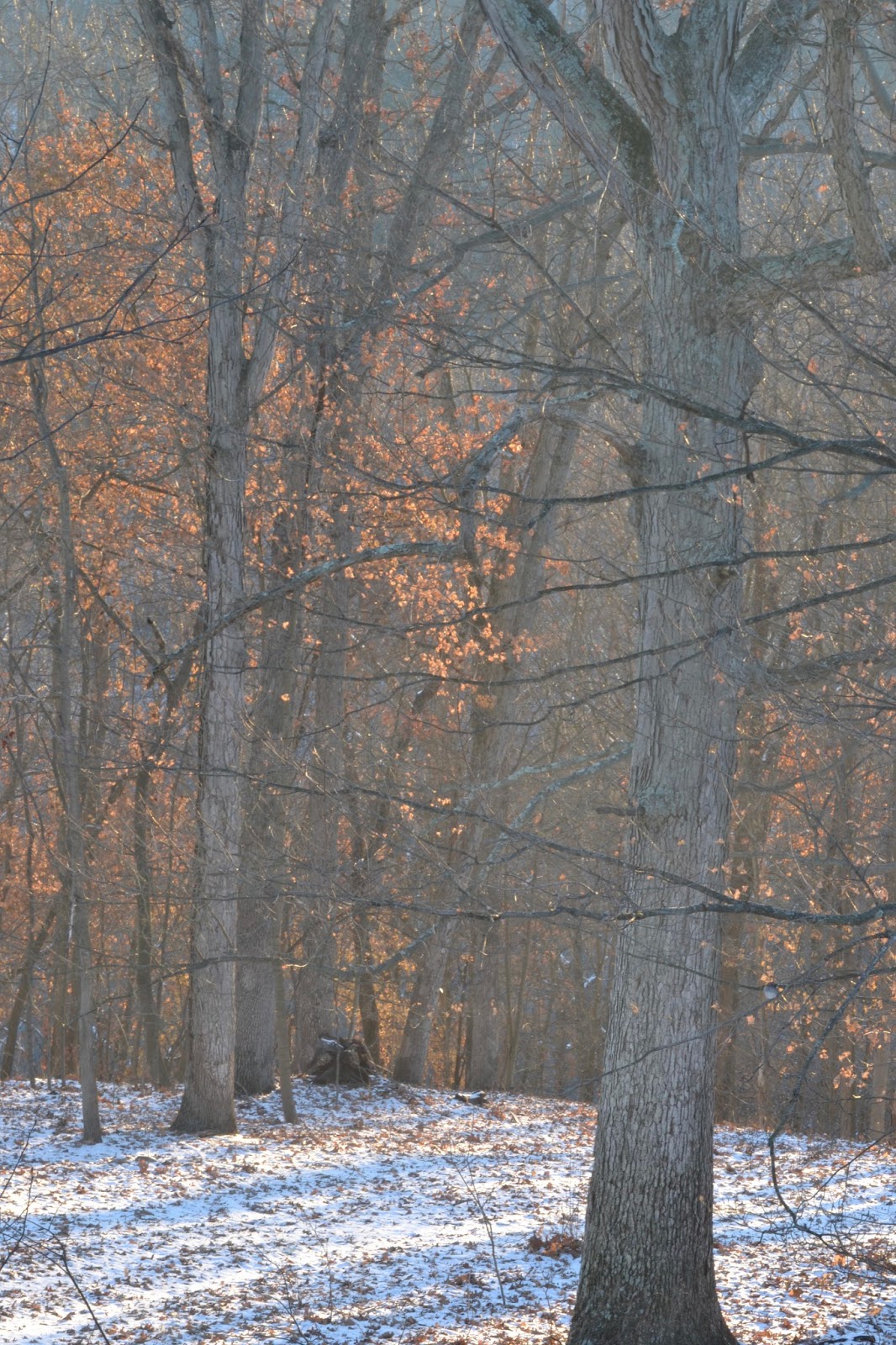
A Woodland Valentine

7:19AM February 14, 2026

“Where else but in nature do we learn to overcome nature and thereby become our humanity—our finite, open-ended transcendence?” Robert Pogue Harrison, Forests: The Shadow of Civilization, p. 231.

     The heart songs offered in forests and woodlands come freely every day. Their blessings enter the window above my desk as well as all windows around our home and perhaps even better when walking amid the oaks and maples. Harrison’s book enriches these experiences with his elaboration on the words and representations articulated by historians, story tellers, poets, and visual artists who have ventured into forests across many lands and ages. One, of course, is Henry David Thoreau. Harrison notes: “The woods do not contain the knowledge that Thoreau seeks by going there; they do, however, uncover the habitual hiding places of the self, leaving it exposed to the facts of life,” p. 222.


February 14 2026

Exploring woodlands through the lens of John Constable’s paintings, particularly Study of a Trunk of an Elm Tree, Harrison furthers an understanding of logos:

… the trunk of the elm tree…stands there as the embodiment of something that has come to appearance, that has emerged from the earth that somehow gives itself over to representation. The tree and its encircling forest, the patch of open sky and its sphere of illumination on the floor of the clearing, appear in Constable’s study in what one might call their pregivenness. The phenomenon is always pregiven, the human presence is that to which it is given. Expressed otherwise, the phenomenon takes its stand within a fundamental relation, or correlation, that binds together the human essence and the self-disclosure of the phenomenon. This relation is logos. Logos is the ‘word’ that keeps silent in the artwork by disappearing into the presence of the phenomenon.

We must go further and say that this fundamental correlation underlies the correspondence between soul and landscape which Constable’s paintings strive to evoke. Constable’s devotion to the light, tone, and atmosphere that pervade a landscape and imbue it with a mood that is like a fusion between human feeling and nature’s appearance—this devotion to the emotional modalities of the chiaroscuro indicate the extent to which, for Constable, human presence in the world belongs most intimately to nature’s manner of being. ‘Painting is but another word for feeling,’ he declared, and feeling is but another word for the relational bond—the logos—through which nature comes to presence in the phenomenon. (p. 208)

This commentary contributes to my sense of the possibilities of photography involving these woods.

     Harrison also meditates on the abundant giving from the woodlands through several poets, especially A.R. Ammons, John Clare, and Andrea Zanzotto. Poignant are the revelations from seasonal expressions shown by forests in relation to longing and loss. Profound are the gifts that flow from fallen leaves covered in snow.

Saturday, November 8, 2025

Harmonizing with Resonance

Energy in autumn leaves, Nov 8, 2025

Sound and light are forms of energy, vibrations, frequencies, bridging for those ready to hear and see the expanse and interiority of space and time, infinity and eternity. One of my very favorite themes, resonance, is wonderfully amplified by Frank Wilczek, winner of Nobel Prize in Physics. From his chapter “Quantum Beauty 1: Music of the Spheres” in A Beautiful Question: Finding Nature’s Deep Design:

Each natural vibration pattern takes place at its own natural frequency.  The natural frequency is also called a resonant frequency, for the following reason. If the frequency of your driving force is close to the natural frequency of some pattern, that pattern will leap out in powerful response. For then, and only then, does the external driving force match up with the internal forces, cycle after cycle, to build up the strength of the motion. (pp. 173-4)

Color in woodlands, Nov 8, 2025


Wilczek calls James Clerk Maxwell “the first truly modern physicist” (p. 7) and quotes from Maxwell’s private journal:

Happy is the man who can recognize in the work of to-day a connected portion of the work of life and an embodiment of the work of Eternity. The foundations of his confidence are unchangeable, for he has been made a partaker of Infinity. He strenuously works out his daily enterprises because the present is given him for a possession.

Thus ought man to be an impersonation of the divine process of nature, and to show forth the union of the infinite with the finite, not slighting his temporal existence, remembering that in it only is individual action possible, nor yet shutting out from his view that which is eternal, knowing that Time is a mystery which man cannot endure to contemplate until eternal Truth enlighten it. (from p. 164 in Wilczek’s A Beautiful Question: Finding Nature’s Deep Design) 

Morning light, Nov 8, 2025

Thursday, October 24, 2024

Reassurance for the Glimpse


“…catching a glimpse of the Divine Nature out of the corner of the mind’s eye…”


   Austin Farrer gives comforting excursions into the territory of the unknown, offering reassurance for feeling lost in the ocean Unknowable. To imagine the eternal through the golden passage in autumnal woodlands is more than wishful thinking.


“…catching a glimpse of the Divine Nature out of the corner of the mind’s eye. We are really saying: since Divine Nature is the standard of what one might expect being simple to be, how does it arise that what our senses meet on every hand is not God, but finite things? And the argument goes on to answer: it is because the finite things have been ordained by God” (p. 45, Reflective Faith).


     Today’s meditation from the Center for Action and Contemplation addresses this relationship to the Living Presence in nature and in mutual relationship with people:

“… In my life, listening is a prime spiritual practice. Throughout the day, I seek to listen. I find that I sometimes hear the words but do not bring my full attention to listening. A friend is speaking to me; am I listening with a quiet mind? I see the beauty of the roses in my garden. Am I listening internally, taking a moment to notice the effect that the beauty of the roses has on me? I hear an undocumented immigrant in my community describe how her family lives in fear. Am I listening with a responsive heart? I read a story in the newspaper about heroin addiction in our state. Am I listening? I study a passage in Scripture. Am I paying attention to the details in the passage? Am I providing the time and attention to notice what the text might be stirring up in me?... (drawn especially from Nahum Ward-Lev, The Liberating Path of the Hebrew Prophets ].


Saturday, February 10, 2018

Tracking on the Path of Attraction


In the account of his forest mandala for early February, David George Haskell focuses on the tracks of deer and their browsing on the emerging tips of winter vegetation. 

This week, the tracks in our woodlands have been quite visible due to the snowfall that has been covering the ground. In addition to the cloven marks of deer, padded footprints run alongside. In recent days, I sighted a coyote and possibly a bobcat. A grey house cat has also been prowling by, maybe from the barn or from neighbors, and bird prints abound. 
        My reading this week gains meaning when viewed in terms of tracking. In first passage through the books, some spot on almost every page or three attracted a marker. After reading, those fluorescent sticky notes made the tracks by which I returned to copy passages and to classify them into categories. Here’s the working set from James Winston Morris’ The Reflective Heart:

  • Bewilderment
  • Discernment
  • Face as symbol  Face of God    veil  cleaning   suffering
  • Friend of God
  • Heart   Tajalli
  • Imagination
  • Journey Voyage -ing
  • Meaning-Making  Self-Recognition   Spiritual Ascension of the Word
  • Secret
  • Spiritual Intelligence  Mahdi
  • Steward    Stewardship
  • Taste   Tasting
  • Tales   Story   Storytellling   Hagiography     Imagination
  • Teaching
  How is it that certain passages and terms emerge from the sea of words, like the young growth that attracts the browsing of deer? Haskell explains in length how a deer takes in the crucial parts that the body, the rumen, is especially receptive to and capable of absorbing. The deer discerns within the environment that which has life-giving power. Perhaps, again, it’s discernment, a term for the title of a key chapter in Morris’ book, that forges or finds a person’s unique pathway.
   As I wondered around this metaphor of tracks and tracking, the term himma came to mind. In attempting to follow the “path of attraction,” some markers or tracks would certainly be helpful because the world has many wolves, gingerbread houses, and givers of toxic apples. So many attractions distract or veil a person from the True Way; these tests range from ascetic to sensational. A tracker has to discern the fit for his or her particular fingerprint marking the Way, the track provided by the Source. In The Reflective Heart, Morris indexes only three pages specifically for himma, but one of them may be sufficient at this point. Translating Ibn ‘Arabi:
We empty our hearts of reflective thinking, and we sit together with the Real (al-Haqq) on the carpet of adab [appropriate courtesy] and spiritual attentiveness (muraqaba) and presence and readiness to receive whatever comes to us from Him—so that it is God who takes care of teaching us by means of unveiling and spiritual realization. So when they have focused their hearts and their spiritual aspirations (himam) on God and have truly taken refuge with Him—giving up any reliance on the claims of reflection and investigation and intellectual results—then their hearts are purified and open. Once they have this inner receptivity, God manifests Himself to them, teaching them and informing them through the direct vision of the inner meanings of those (obscure scriptural) words and reports, in a single instant…They limit (the meanings of these scriptural or prophetic expressions) to what (God) actually intended by them—even if that very same expression occurs in another report (with an entirely different intended meaning). (p. 61)
In her book on Hafiz, Elizabeth Green clarifies the meaning of himma: “‘high spiritual energy or ambition,’ spiritual power that enables an adept to attain higher planes of experience and understanding, and that enables the pir [spiritual guide] to protect his disciples” (p. 148, The Green Sea of Heaven). I’ve sometimes connected himma with an increased heartbeat or a sense of close attunement with purpose, the raison d’être. In Music of the Soul, Shaykh Muhammad Sa’id al-Jamal connects himma with a personal favorite:
“… you could say himma is like a horse and when the ‘arif (the knower of the truth) puts himself on this himma, he flies, travelling. Without himma, no one can walk. . . The knowing is himma.” (p. 285, note 11).
This tracking, this connection with himma, or with whatever mark one calls the trace of the True Way, cannot be underestimated. Rumi reminds us:
The Master said: There is one thing in this world which must never be forgotten. If you were to forget everything else, but did not forget that, then there would be no cause to worry; whereas if you performed and remembered and did not forget every single thing, but forgot that one thing, then you would have done nothing whatsoever. (p. 26, Discourses of Rumi, Trans. A.J. Arberry; See also, Coleman Barks for Feb 9, “The One Thing You Must Do” in A Year With Rumi and p. 21 in Say I Am You).


Tuesday, January 30, 2018

Winter’s Invisibility Cloak

Our woods on January 30, 2018
For January 30, David George Haskell in The Forest Unseen, writes, “plant resurrection after a full surrender is so far removed from human experience…” (p. 22). And yet the Path of Attraction* calls to us humans, urging the full surrender of the ego-self. Instead of a contrast, I find that Haskell’s elaboration of the winter woods offers a helpful model for our development through wintry conditions.
   Haskell describes how most plants survive through freezing winter by moving the essential to the center: “Plants start their preparations several weeks ahead of the first freezes. They move DNA and other delicate structures to the centers of their cells” (p. 22). In similar fashion, in order to survive the freezing times that worldly life brings toward the soul, humans need to follow the example of the plants’ preparation. 
   Importantly, the testing times of winter demand the development of discernment. Purification of the human heart means discerning the individual’s spiritual DNA. Coleman Barks places a Rumi poem here in the midst of winter where it teaches us about the ability to discern true ecstacy: “There are thousands of wines/ that can take over our minds.// Don’t think all ecstasies are the same./ Jesus was lost in his love for God./ His donkey was drunk with barley.”** Yes, humans need the “fire” from wine in order to make our way through winters, but we have to choose the wine of spiritual ecstacy over the intoxications of pride, ambition, domination, as well as alcoholic drunkeness.
   If a human surrenders the ego, surviving the winter of life might be possible. Haskell’s elaboration of his woods in Shakerag Hollow offers helpful models for us. In addition to the way taken by perennials, he notes “a different path”: 
Leafcup herbs completed their short eighteen-month lives last fall and now stand dead, surrendered entirely to winter. They have sublimated into a new physical form, like snow passing into vapor. Like vapor, these new forms are invisible, but they surround me…seeds, waiting out winter…When spring sparks the mandela, the energy released will carry the whole forest, birds included, through another year. [p. 24]
   Haskell’s account stirs several themes worthy of meditation. For one, consider the value of going invisible. Of course we saw the power of the Invisibility Cloak for Harry Potter. Perhaps less apparent is the value of the quiet life somewhat protected from the storms of status, wealth, and winning. When we realize this, we have gratitude for not being seen, for not receiving the “merit” bonus, even for losing the world’s prestige. The authentic life of the individual soul has to be known in secret. 
        Or perhaps there are sightings or scents but only accessible to those prepared to receive them. The pathway toward God moves into the invisible, the inarticulate, the ineffable. I believe that human capacity for such movement develops, for example, when engaging Good Stories through increasing discernment of “resonance,” by discriminating the authentic, the holy. Although I’ve just discovered the book, I’m excited to open John Renard’s Friends of God where his Preface notes “when an author appears to have slipped off the straight path of ‘fact’ onto the mucky byways and quick sands of credulity” and going forward as “travelers in the realms of the religious imagination” guided as “smaller stories communicate the ineffable” (xiii-xiv). God’s light breaks through every instant but catching the rainbow spectrum takes special vision. These new forms wait out winter preparing to spark into spring.
==================
* Path of Attraction is “code” for following God’s light, for the “Religion of Love,” perhaps even signaled by the code-word  resonance” that I use in Good Stories [clink on the resonance “label” at bottom of blog], and for continuing purification needed to track or to be drawn by the Source, the Truth… 

** From p. 40 for January 28 in A Year with Rumi, taken from Mathnawi IV, 2683ff. In the passage, Rumi warns us that these two “wines” (infidelity vs. true religion, line 2716; carnal soul vs. reason, line 2718) are “at war: take heed, take heed, and strive that the spiritual realities may prevail over the (sensual) forms” (line 2719, Nicholson’s translation).
In her notes for Hafiz’s ghazal 5, Elizabeth Gray comments on the symbol: “Wine has a rich array of meanings and resonances in Persian poetry, and is associated with light, illumination, and truth… The surface of the wine in the wine cup reveals the face of the Beloved, the reflection of one’s own face (which is a mirror of God as His creation, and therefore is Him)” (p. 147, The Green Sea of Heaven.)

Wednesday, January 24, 2018

Human-Divine Harmony


Part 3 in the year-long series of looking at our woods through the lens of David George Haskell’s The Forest Unseen. 
   Haskell’s entry for January 21 focuses on comparing chickadees’ survival in extremely cold conditions with humans’ coping through fire, clothing, and food storage. In contrast with species that evolve to accommodate nature, I wonder about humans’ role in shaping the environment. When Haskell strips his clothes to simulate the bird’s experience, within seconds his body starts to shut down and soon he would have become unconscious and dead. Instead he covers up with warm insulating clothes and returns to his toasty kitchen, fueled by burning wood, powered by petroleum, sun, wind, or nuclear energy. When is this thing we call “civilization” in harmony with all-our-relations and when not?
   In our woods from January 20-23 in 2018, snow was melting, then temperatures peaked at 60 degrees, about 20 above normal, followed by rain and overnight freezing. On the warm days, I was working up a good sweat removing invasive plants from our woodland. This thing called “civilization” is crazy-making, and then perhaps it also allows a place to find/receive God.
   Perhaps humans just have to fall; in other words, to learn harmony, we first mess things up. Most of the mess in our woods came in by humans who thought they knew better. For example, "bush honeysuckle”:
…first introduced into the United States in the mid to late 1800s from Europe and Asia for use as ornamentals, wildlife food and cover, and erosion control. . . [But] Honeysuckle out competes and shades out desirable native woodland species, and can form pure, dense thickets totally void of other vegetation. . . While honeysuckle fruit is abundant and rich in carbohydrates it lacks the high-fat and nutrient-rich content that most of our native plants provide migrating birds. Wherever invasive honeysuckle shrubs displace our native forest species there is a huge potential impact on these migrating bird populations due to the reduction in availability of native food sources.  https://ohioline.osu.edu/factsheet/F-68 
   Soon after we were adopted by these woods, the missing native trees along with our birds asked me to take care of a thicket. While doing this has produced buckets of sweat, effects of poison ivy, ticks, etc., it’s also brought the joy of stewardship and thus the presence of the Divine. Tending these woods and being tended by them: that’s a divine harmony. In my view, it’s allowed one of the “very special human doorways to true religious understanding…and finally as God’s true earthly ‘stand-ins’ or ‘Stewards...’” The passage comes from James Winston Morris’ forthcoming book, Openings:
"First, and most importantly, it is human Hearts (the Qur’anic qalb al-insān) that are the locus of true spiritual ‘Knowing’ (‘ilm) and of our awareness of God and Truth: that is, it is not simply our mind or intellect or passion. Hence the decisive practical importance, throughout the Nahj al-Balāgha, of Ali’s constant stress on the purification of our hearts, through inner surrender to the divine Will (taslīm), as the underlying spiritual purpose of the many divine commandments. Divine, inspired ‘Knowing,’ however it is outwardly acquired, can only be perceived as such by the Heart that has been ‘polished,’ emptied of this world’s distractions and attachments, and thereby opened up to the full significance and reality of the divine Word—and to the further rights and obligations (another dimension of the Arabic al-Haqq) flowing from that opening. 
     Second, the practically indispensable key to this human potential for religious Knowing is the real existence and efforts of a limited number of divinely guided individuals—again, not of particular books, rituals, doctrines or worldly institutions, none of which are even mentioned in this intimate, highly personal lesson. Ali refers here to those very special human doorways to true religious understanding by several profoundly significant Qur’anic expressions: the ‘divine Knowers’; the ‘Friends of God’ (awliyā’ Allāh); God’s ‘Proofs’ or ‘Clear Signs’ on Earth (hujja, bayyina); God’s ‘True Servants’ (‘ibād Allāh); and finally as God’s true earthly ‘stand-ins’ or ‘Stewards’ (khalīfat Allāh).” [reference to Qur’an 6:165]
   While Morris is not explicitly talking about tending woodlands, I find very helpful his elaboration of stewardship in the context of searching for the heart-space that connects the human with the divine. What a blessing it is to feel the peace, beauty, and harmony in mature woodlands.
Pileated Woodpecker…a keystone species in mature and old forest”

Thursday, January 18, 2018

Divine Intoxication

Our Tavern of Woods, Jan 17, 2018
In comic-strip pith, “Word” signals “That’s it!” as in “Truth!” But in real life, words only approximate and often miss the mark, frequently crafted with intention to deceive, witnessed poignantly in the discipline of rhetoric. Her cousin, Religion, focuses on guiding discernment into truth, plumbing the eternal word becoming flesh, tuning the human voice toward resonance with its Source. Both rhetoric and religion testify that not all, not even most, scratching on surfaces  approaches the sanctity of “Word.” And yet this writing and reading, this employment of words sometimes corrects a false step, sometimes allows a a scent or taste of the water of life, the "mystical intoxication."
   Concerning taste, this preoccupation with “word” came about, perhaps, due to the trouble stirred up by Hafiz choosing to feature “tavern” when “temple” is meant—isn’t it? Franklin Lewis, in his chapter in Hafiz and the Religion of Love (Ed. Leonard Lewisohn), comments:
“Thus the wine tavern becomes the locus—the ruins on the outskirts of town, where the non-Muslims drink clandestinely so as not to offend public morality, the liminal space outside society—while the dawn becomes the poetic moment when divine intervention arrives, allowing wine and relief, or mystical intoxication. [Lewis illustrates with the first line of Ghazal 479] ‘At dawn a call from the wine tavern, wishing good fortune/ It said come back, for you are an old haunter of this court.’” (pp. 274-5)
The next line from the ghazal extends the purpose of Hafiz playing the word “tavern.” In Peter Avery’s translation:
“A draught from us drink like Jamshid, so that of both worlds’ mystery/ The beam of light from the world-seeing cup might inform you.” (p. 580, Collected Lyrics of Hafiz of Shiraz)
Of course, in the spirit of good mythopoesis, Hafiz wants to shake us, to wake us, in order that we might search out hypocrisy, alert for hidden idols, finding the ones that continue to separate us from the Love of God; that we might come back to the source of inspiration, walking in the mystery of both worlds. 
God invites us every moment to do this, to purify in order to live more cleanly. To help me enter the invitations, as explained earlier, I’m intending a year-long project that connects (A) David George Haskell’s study (The Forest Unseen) of his forest mandela with 
~14 cardinals
(B) the woods that illumine our windows. We’re now on his second entry, the one for January 17. On this date, his woods like ours are filled with snow. We wonder how the snowflake reaches its essential uniqueness, turning through the spirit wind, glistening in the illuminating light.
Haskell’s meditation (pp. 8-11) flows back to Johannes Kepler (1611) who “wrote that snowflakes are showing us the spirit of the earth and God, the ‘formative soul’ that inhabits all being.” Yet Kepler was frustrated in not showing “a material explanation” and still his “musings on the snowflake…contributed to the development of our modern understanding of atoms.” Haskell brings our contemporary X-ray analysis to the design of matter: our woods, water, and us.
“The basic hexagonal shape of snowflakes is elaborated in varied ways as the ice crystal grows, with the temperature and humidity of the air determining the final shape… Other combinations of temperature and humidity cause the growth of hollow prisms, needles, or furrowed plates. As snowflakes fall, the wind tosses them through the air’s innumerable slight variations of temperature and humidity. No two flakes experience exactly the same sequence, and the particularities of these divergent histories are reflected in the uniqueness of the ice crystals that make up each snowflake.” pp. 9-10
As a side note, Kepler has also received recent attention in relation to his role in enlightening dark consciousness evident in witch hunts, including the one involving his own mother.* 
The human defines the authenticity of word as the individual resonates uniquely back into the original promise, the timeless covenant between God and human, the affirmation of sovereignty. Humans also revolve through cultural drafts and shadows that challenge each of us to sound the authentic word that is true to the Source. Thus, again, the purpose of religion. 
        Sufis talk of this walking as the Path of Attraction. But life abounds with attractions, and so many are bewitchments from the impurities picked up in the currents of culture. The true calling is to discern, to follow, and to voice the Word. God is Everywhere. The purification back to the Source leads to and follows from entering more deeply into Beauty, Truth, Love, and the array of qualities endowed uniquely in each individual.
=================
* Ulinka Rublack, The Astronomer and the Witch, Oxford, 2015.

James A. Conner, Kepler's Witch: An Astronomer's Discovery of Cosmic Order Amid Religious War, Political Intrigue, and the Heresy Trial of His Mother. Harper, 2005.

Wednesday, January 3, 2018

These Frosty Woods

Jan 1, 2018 viewed from upstairs study
          For friends who notice the photos I post on Facebook, my love affair with deciduous woodlands will come as no surprise. The view from the upstairs desk mesmerizes me, even taking me from the mystical readings; maybe it’s not a separation but rather a union! These two must be of one spirit. The best pages breathe their origin, the inner fiber of tree; both transmit inspiration.
          My romance with books often gets teased by the spell of Maria Popova’s reviews. About a month ago, she featured David George Haskell’s recent book, Song of Trees. The tease enticed me to chose his earlier book: “The Forest Unseen: A Year’s Watch in Nature (Viking, 2012, https://dghaskell.com/theforestunseen/), winner of the National Academy of Sciences’ Best Book Award for 2013, finalist for the 2013 Pulitzer Prize in nonfiction, winner of the 2013 Reed Environmental Writing Award, winner of the 2012 National Outdoor Book Award for Natural History Literature, runner-up for the 2013 PEN E. O. Wilson Literary Science Writing Award…” 
         The book has 43 short chapters, each based on his observations and musings focused around a spot “of old-growth forest in the hills of Tennessee.” Every few days through the year, Haskell watches this forest mandela that is about a meter across. He connects this to Tibetan mandelas (p. xii). My intention is to read his book throughout 2018 and to ask this reading to inspire my walking in our woods. 
         Haskell’s first entry comes on January 1. He features lichens whose “vibrancy contrasts with the winter-weighed lethargy of the rest of the forest.” He continues:
Supple physiology allows lichens to shine with life when most other creatures are locked down for the winter. Lichens master the cold months through the paradox of surrender.” (p. 2) 
          Our woods, some 600 miles northeast from Haskell’s forest, look pretty locked down on January 1, 2018, still frosted with snow, temperatures below freezing all week, dropping to near zero at night. It is cold. Still I look for lichen, trying not to lock down for winter.

lichen on rocks ?
lichen on tree trunk ?

close up of lichen (?) on rocks 
          Haskell enriches his observation about the lichens’ paradox with an anecdote about a fourth century BCE Chinese Taoist philosopher and then elaborates the biological explanation. He comments on their means of survival:
By stripping off the bonds of individuality the lichens have produced a world conquering union. . . the lichen partners have ceased to be individuals, surrendering the possibility of drawing a line between oppressor and oppressed. (p. 3)
hmm...what's this?
Interesting...but sacrifice of individuality? Yikes--but that does sound rather like the Sufi mystics on surrendering the self. 
         While we might celebrate the “winning partnerships,” Haskell keeps us from imagining only unseen rosy hints when he also notes the presence of piracy and exploitation. And yet: “Even piracy is powered by collaboration” (p. 6). 

When you look out (and in), can you see these fascinating happenings?


Next up: “January 17—Kepler’s Gift” pages 8-11. The woods keep calling.