Showing posts with label translation. Show all posts

Sunday, January 10, 2021

Path-Maker Breaking Stones

"We make the road by walking," photo, January 9, 2021
The primary offering of a mystical text, in my experience, comes in the uniquely personal breaking open of the divine, often only as an elusive whiff at the edge of the articulate, a breeze that dares one to go beyond frozen thought patterns, to venture past traditions that violate the sanctity of freedom. And almost paradoxically, this freedom conjoins with unity, as Rabindranath Tagore told in his Nobel Prize Acceptance Speech: “We must discover the most profound unity, the spiritual unity between the different races…… He who sees all beings as himself, who realises all beings as himself, knows Truth.” This focuses the heart of Gitanjali, the force that Coleman Barks seeks to liberate and preserve.

        The beckoning pathway forms in glimpsing, in tasting the mystery that remains mysterious while also flavoring the everyday with a texture of life beyond. With this expectation, I looked forward to Fons Vitae’s publication of Coleman Barks’ “translation/version” of Tagore’s Gitanjali (Song Offerings). Having often found support in “making the road by walking” through Barks’ versions of Jalaluddin Rumi (which he fashioned from English translations by Arberry, Nicholson, and others), how would Barks enhance the vitality in Tagore’s own English translation from his native Bengali in the work which led to Tagore’s Nobel Prize award?

        In addition to the 103 songs comprising Gitanjali, Barks includes four additional poems from Tagore’s work, The Crescent Moon, and Barks also gives us a dozen pages of his own commentary and notes. I’d like an additional hundred pages of Barks’ commentary, and still I find that the concentrated material contributes by showing the involvement of W.B. Yates, Ezra Pound, and others as well as pointing to connections with Ghandi and Kabir.

        Barks begins, “Rabindranath Tagore is one of the great universal mystics.” Again, to me, the role of the mystic and thus of mystical text features access to the holy, so that the individual breathes the unique essence that purifies, inspires, and vitalizes, so that he or she moves forward on the pathway “made by walking” (e.g., Antonio Machado, in Campos de Castilla, Proverbios y Cantares, #29) and bridges “these daft twin brothers, life and death” (from Tagore’s #58, p. 76). Barks’ version, just cited, shows the light touch, which serves as a little wake-up invitation, in part through the addition of “daft” to Tagore’s English translation which reads: “the joy that sets the twin brothers, life and death, dancing over the wide world…” (p. 149 in Visva-Bharati/UBS Publication of Gitanjali). Barks also features, in the next line, “the storm” in a way that moves me differently from Tagore’s “tempest.” 

        It’s not that one translation/version is better than the other but that a force may be invoked to join the dance, to broker the mystical encounter. In Gitanjali, Tagore offers a departure from conventional religion. For example, number 11 opens:

“Leave this chanting and singing and telling of beads!

Whom dost thou worship in this lonely dark corner of a temple with all doors shut?

Open thine eyes and see thy God is not before thee!

   He is there where the tiller is tilling the hard ground

and where the path-maker is breaking stones…” 

     (p. 23 in Visva-Bharati/UBS)

Barks’ version goes:

“Give up this fumbling with beads, this chanting 

     in the dark, shut temple.

… A mason

     is breaking and laying stone for a path.”

      In number 102, Tagore, with beautiful respect for the individual’s responsibility and authority for path-making, tells of people who demand “Tell me all your meanings” and he responds, “‘Ah, who knows what they mean!’ They smile and go away in utter scorn./ And you sit there smiling.” (p. 253 in Visva-Bharati/UBS)

Barks’ version of the middle part of #102 offers, “A secret part of you flows out of me.” 

For me, the chance for a bit more of this secret is the offering from the publication of What Wants to Come Through Me Now. 


Thursday, March 28, 2019

“Interpret Your Own Self”


Sunrise March 28
Some weeks before attending the Radical Love event at the Garrison Institute, I was already well into Alan Williams’ Rumi: Spiritual Verses, his translation of Book 1 of the Masnavi. Soon after returning from the Institute and while completing that book, a particularly compelling passage called out: “Interpret your own self” (3758). Williams’ notes tell that this line is “almost identical” to 1088b. So looking back, I find, sure enough, a green sticky marker there pointing to #1088 in the way that I use for the few passages that jump off the page shouting: “Pay attention here!” So what might “Interpret your own self” mean and why is it so important? 
     I believe that this act of interpreting leads me further in the journey of knowing myself and thus connects with the awe-inspiring hadith: “to know oneself is to know one’s Lord.” This challenge continues to provide a bridge between authoritative text and personal construction of meaning.  Samples of previous explorations of the hadith include blogs from 2017: Sept 20, Sept 23, Nov 1, & Dec 16. When I look back at Chittick’s Me & Rumi: The Autobiography of Shams-i Tabrizi, I find this hadith frequently cited (see his listing on p. 357) and particularly in #58 (p. 69) that traces through Moses, Jesus, and Muhammad toward today: “He who knows his soul knows his Lord.”
     I’d probably been prepped for Rumi’s “Interpret your own self” by simultaneously reading Jawid Mojaddedi’s Beyond Dogma: Rumi’s Teachings on Friendship with God and Early Sufi Theories, followed by William Chittick’s Science of the Cosmos, Science of the Soul. For example, from Beyond Dogma, I feel reassured in my sense that, properly approached with sufficient humility, it’s not too presumptuous to read and interpret Rumi’s Masnavi as direction, as a personal invitation to each individual, for moving closer to the Presence. In short, Rumi guides a person toward knowing him/herself in the way that knows one’s Lord.
     Mojaddedi discusses this ultimate access as coming through “contemporary Friends of God.” In other words, access to the Divine is not locked away in some remote revelation, in an almost indecipherable language where those saints who communicated with God are so unreachably far above us that we just have to follow recipes. Instead, Mojaddedi explains Rumi’s “assertions about the comparable loftiness of contemporary Friends of God, and especially the leading Friend of God of every era”:
“The priority of this concern for Rumi would also account for his emphasis on the shared potential of all people to reach the lofty level reached by Prophets and Friends of God, if they fulfill their mystical potential. . . Rumi’s predilection was to emphasize the closeness of all humanity to the divine…” (pp. 39-41)
This reminds me of Chittick’s calling the “human soul a potential intellect” (Science of the Cosmos, p. 127) and asserting “the only created thing that is omniscient in any real sense is the fully actualized intellect, the radiance of God’s own Selfhood” (p. 128; cf all of Chapter 6 on this potential).
     Mojaddedi elaborates on the basis for our means “to interpret”: “the most distinctive characteristic of [Rumi’s] mysticism is his celebration of the continual communication of God with His creation.” He provides a footnote: “I have decided to use the term ‘communication’ in preference to alternatives such as ‘inspiration’ or ‘revelation.’ The term ‘wahy’ is notoriously difficult to translate and has taken on two dimensions of meaning in relation to Prophets …” (footnote 5, p. 185). Mojaddedi further discusses the difference (and overlap?) between ‘verbal expression’ and ‘internal/non-verbal promptings’ and ‘inspirations.’ This discussion continues with lines from Rumi’s Masnavi as Mojaddedi says that Rumi “describes the Friend of God’s knowledge in the following terms:
The Tablet that’s Preserved was his director— / From what is that ‘preserved’? From any error.
Not through stars, magic or one’s dreams at night,/ But wahy-i haqq and He knows best what’s right!
Sufis may call it mere ‘heart-inspiration,’/ To hide it from the general population.
It’s ‘inspiration of the heart,’ since He/  Is manifest there—it’s thus error-free.
Believer, through God’s light you now can see;/ From error you have full immunity!”
(Mojaddedi in Beyond Dogma, p. 65, translating from Book 4 of the Masnavi, lines 1852-1856. In his more recently published Book 4, Mojaddedi translates wahy-i haqq as “God’s own words,” p. 112.)
So how does the direction to “Interpret your own self” play itself out? I’m finding that “the path of attraction,” as it applies specifically to listening for which readings stir the beating of my heart, is leading me back to the writing left by the guide whose hand I took. It happened like this: I noted my response (an “internal/non-verbal prompting” perhaps) to a comment Omid made in the Radical Love Institute about angel wings on donkeys. He told me it came from Rumi’s Fihi, translated by Thackston in Signs of the Unseen, somewhere in the middle of the 246 pages. I’d already begun reading in this book and, upon returning home, scanned to see if I could find the passage. Didn’t work; so, more properly directed, I started at page one and read forward, finding (pp. 111-112) the angel-feather-on-donkey-tail passage, and kept going. I noticed along the way that Thackston frequently referenced Tales of the Prophets of al-Kisa’i and felt another point of attraction, this time to the Kisa'i text. But, as often happens on a travel, while considering getting a copy of Kisa'i, I felt drawn to other collections of similar tales already on our shelves (Ibn al’Arabi’s Bezels of Wisdom, Attar’s Memorials of God’s Friends, Heschel’s The Prophets) but these were not lighting up. Instead, I was caught by a book with which I hadn’t connected in earlier attempts--our Sidi’s Stories of the Prophets ( by Shaykh Muhammad al-Jamal ar-Rifa'i as-Shadhuli). It had not especially resonated when I’d tried it a few years earlier. Now it rings like a bell or maybe like the lovely chimes on our porch.


Saturday, April 7, 2018

Blessed Re-Emergent Spring


One week ago, the full blush of spring radiated from the azalea festival in Tyler, TX, highlighted by dogwoods, redbuds, wisteria, and even the smiling new-green deciduous trees. This we forfeited in driving northeast, returning home, still adorned in winter earth tones. And yet the loss finds redemption in allowing the feel of manifestation, the pre-budding, the reassurance of imagination, of intuitive knowing, of faith which is the evidence of the unseen. This tantalizingly slow emergence of spring feeds the soul.
“… opening of a window in the heart towards the unseen also takes place in conditions approaching those of prophetic inspiration, when intuitions spring up in the mind unconveyed through any sense-channel” (The Alchemy of Happiness, Abu Hamid Al-Ghazali, Trans. Claud Field, pp. 19-20).

        Yesterday shuffling through the dusty leaves fallen last autumn, I almost stumble over the pale blooms of bloodroot. This modest forerunner of spring holds the miraculous powers of rejuvenation. Its long history of medicinal uses includes promises such as these:
“to prevent certain types of cancer, protect against infections, boost heart health, improve the appearance of the skin (including elimination of conditions like eczema), speed healing and recovery, increase circulation, and soothe the pain of migraines . . . a very powerful plant and can be dangerous (even toxic) if used incorrectly.”  https://www.organicfacts.net/bloodroot.html
         Returning from our trip to the Southwest, we also stopped in Athens, GA, hoping to find the coffee-house where Coleman Barks tapped the life-spring of Jalalu’ddin Rumi. In the one we found, they told us Coleman recently did a reading there but that his coffee shop was probably no longer around. Like spring flowers so soon gone from sight. But not gone, just waiting. Ghazali again:
“The first step to self-knowledge is to know that thou art composed of an outward shape, called the body, and an inward entity called the heart, or soul. . . In truth [the heart/soul] does not belong to the visible world, but to the invisible, and has come into this world as a traveller visits a foreign country for the sake of merchandise, and will presently return to its native land” (p. 18).
        Back home, I’m catching up on reading from Coleman’s Year with Rumi , one window into that invisible space and treasure. For April 6, he gives “Blessing”: “I want to be where/ your bare foot walks,// because maybe before you step,/ you will look at the ground./ I want that blessing.”


Wednesday, January 24, 2018

Human-Divine Harmony


Part 3 in the year-long series of looking at our woods through the lens of David George Haskell’s The Forest Unseen. 
   Haskell’s entry for January 21 focuses on comparing chickadees’ survival in extremely cold conditions with humans’ coping through fire, clothing, and food storage. In contrast with species that evolve to accommodate nature, I wonder about humans’ role in shaping the environment. When Haskell strips his clothes to simulate the bird’s experience, within seconds his body starts to shut down and soon he would have become unconscious and dead. Instead he covers up with warm insulating clothes and returns to his toasty kitchen, fueled by burning wood, powered by petroleum, sun, wind, or nuclear energy. When is this thing we call “civilization” in harmony with all-our-relations and when not?
   In our woods from January 20-23 in 2018, snow was melting, then temperatures peaked at 60 degrees, about 20 above normal, followed by rain and overnight freezing. On the warm days, I was working up a good sweat removing invasive plants from our woodland. This thing called “civilization” is crazy-making, and then perhaps it also allows a place to find/receive God.
   Perhaps humans just have to fall; in other words, to learn harmony, we first mess things up. Most of the mess in our woods came in by humans who thought they knew better. For example, "bush honeysuckle”:
…first introduced into the United States in the mid to late 1800s from Europe and Asia for use as ornamentals, wildlife food and cover, and erosion control. . . [But] Honeysuckle out competes and shades out desirable native woodland species, and can form pure, dense thickets totally void of other vegetation. . . While honeysuckle fruit is abundant and rich in carbohydrates it lacks the high-fat and nutrient-rich content that most of our native plants provide migrating birds. Wherever invasive honeysuckle shrubs displace our native forest species there is a huge potential impact on these migrating bird populations due to the reduction in availability of native food sources.  https://ohioline.osu.edu/factsheet/F-68 
   Soon after we were adopted by these woods, the missing native trees along with our birds asked me to take care of a thicket. While doing this has produced buckets of sweat, effects of poison ivy, ticks, etc., it’s also brought the joy of stewardship and thus the presence of the Divine. Tending these woods and being tended by them: that’s a divine harmony. In my view, it’s allowed one of the “very special human doorways to true religious understanding…and finally as God’s true earthly ‘stand-ins’ or ‘Stewards...’” The passage comes from James Winston Morris’ forthcoming book, Openings:
"First, and most importantly, it is human Hearts (the Qur’anic qalb al-insān) that are the locus of true spiritual ‘Knowing’ (‘ilm) and of our awareness of God and Truth: that is, it is not simply our mind or intellect or passion. Hence the decisive practical importance, throughout the Nahj al-Balāgha, of Ali’s constant stress on the purification of our hearts, through inner surrender to the divine Will (taslīm), as the underlying spiritual purpose of the many divine commandments. Divine, inspired ‘Knowing,’ however it is outwardly acquired, can only be perceived as such by the Heart that has been ‘polished,’ emptied of this world’s distractions and attachments, and thereby opened up to the full significance and reality of the divine Word—and to the further rights and obligations (another dimension of the Arabic al-Haqq) flowing from that opening. 
     Second, the practically indispensable key to this human potential for religious Knowing is the real existence and efforts of a limited number of divinely guided individuals—again, not of particular books, rituals, doctrines or worldly institutions, none of which are even mentioned in this intimate, highly personal lesson. Ali refers here to those very special human doorways to true religious understanding by several profoundly significant Qur’anic expressions: the ‘divine Knowers’; the ‘Friends of God’ (awliyā’ Allāh); God’s ‘Proofs’ or ‘Clear Signs’ on Earth (hujja, bayyina); God’s ‘True Servants’ (‘ibād Allāh); and finally as God’s true earthly ‘stand-ins’ or ‘Stewards’ (khalīfat Allāh).” [reference to Qur’an 6:165]
   While Morris is not explicitly talking about tending woodlands, I find very helpful his elaboration of stewardship in the context of searching for the heart-space that connects the human with the divine. What a blessing it is to feel the peace, beauty, and harmony in mature woodlands.
“Pileated Woodpecker…a keystone species in mature and old forest”

Thursday, January 4, 2018

Faces of the Beloved

photo from when Joseph & Leg’cy first partnered up,
circa 2007. Taken & framed by beloved Belqis.
The Religion of Love pretty much says it all, and at the same time leaves one free-falling, ecstatic, as if intoxicated, calling for imagery of taverns, love-making, and (especially for me) horses.* The Persian mystic poets leave me breathless that way. From a random page of Hafiz:
“…From the demonic rival, I take refuge in my own God;/ For the sake of God, that gleaming star might grant some help.//  If your black eye-lash has our blood in its sights,…/ When you set your cheek alight, you burn up the heart of a world…” **

Avery’s footnote to “cheek” states: 
“The “cheek”, izar (also rukh ): Shabistari defines the cheek as the stage on which the Divine Beauty is revealed. The cheek is the jamal, the beauty of God, the vestibule to God’s jallal, His Glory and Power. The cheek is the Divine Essence manifested in its names and qualities.” **
         This wonder-full especially happens when life-experience throbs deep in the heart and calls up in its inimitable, undeniable way: “Truth!” Within each individual, a feeling that eludes the meaning-making of the schooled-mind waits to be owned and known through the heart. It may have to wait a long time, to the end of time? Searching out, forging a good connection with passion deserves high priority. 
         Natural horsemanship requires collection. While driven by passion, my horsemanship demanded many years of riding and groundwork before I could claim to be true the subtle vibrations that my body had long known but could not get through to my conscious knowing because the schooled mind refused to yield. I say “schooled-mind” because Reason must not be devalued. The mind, when cleaned, plays a crucial role in discerning the path. It’s when a person’s thinking (or any other function) presumes to know more than God that it has to be dethroned by surrender. David George Haskell gives a marvelous example of this: “Lichens master the cold months through the paradox of surrender” (The Forest Unseen, p. 4; for elaboration, see These Frosty Woods). ***
         Usually, perhaps optimally, in order to feel heart-resonance fully, the surround space stands still, silent, as if bowed, waiting to be witnessed. Yet in a rushed, distracted world, this deep-bass-voiced “Amen” from a Hallelujah chorus risks never being heard. That’s why I look long into the winter woods, the patient leaves, gold-toned, drawing me further and farther in. 


It’s remembering dreams, both kinds. For me (as in Good Stories), it’s also returning to traditional tales, allowing old ones to come true again, at any moment, as they tell the meaning of otherwise inarticulate experience.
"All the tales of great lovers and the fables of the heroic champions of yore thus become part of the soul’s psychohistory. They pertain to the inner journey of the poet…These are not legends, but living facts of the heart that appear constantly in their verse; they are, as Emily Dickinson says, ‘Bulletins all Day from Immortality’. . . in the Religion of Love such circumstances fill the mystic’s presential awareness. These legends are tangible issues of the present moment that facilitate the lover’s pursuit of Eros, food for his soul that he consumes hoc tempore in the pursuit of knowledge, goodness and beauty, which incite him to excel in the only serious sport: Amor. "  Husayn Ilahi-Ghomshei, pp. 100-2.****
         When passion marks the pathway, the meaning of “God is love” continues to unfold. Even heartbreaks trace the mystery, perhaps more than the good times. Jesus is alive in any religion that has Hafiz.
"Likewise, the Sufi poets consider the appearance of Jesus as an ever reoccurring event sustaining them in the present, using in this context the metaphor of the Messiah’s breath of inspiration’ (dam-i masih). Hafiz alludes to this in two verses: ‘Love’s physician is compassionate and endowed/ With the breath of Jesus,/ But whom should he assuage/ If you are without pain?’  and ‘To whom may I relate such a subtlety?/ She killed me—my stony-hearted mistress,/ Yet possessed the life-giving breath of Jesus.’ "Husayn Ilahi-Ghomshei, pp. 101-102. ****
         When I trace passion’s pathway, I re-see my falling in love with horsemanship as it revealed the delicacies of power, more through the body than the mind. Another touch comes in the tender yet ecstatic touch of Beauty that clicks any second in the shutter release of a camera open to the master artist’s palette. The Beloved appears in the faces of whatever lines have been pre-formed in each human’s origin. From Husayn Ilahi-Ghomshei’s section “The Primordial Disposition of Man and the Religion of Love”:
"According to the Qur’an, man was created with an ‘original disposition that God instilled within him’ (fitrat Allah ) and formed with a ‘fundamentally immutable God-given nature’ (la-tabdil li-khalqi’illahi , Q30:30). Basing themselves on this evidence from their holy scripture, Persian poets drove this classical theolgical doctrine up several theosophical notches higher, maintaining that man’s nature had been already moulded and framed to develop according to the nature of the divine attributes of Beauty, Truth and Goodness, and inclined to follow the ‘Straight Path of Love and Mercy’ (‘ishq, mahabbat, rahmat ) long before birth."  Husayn Ilahi-Ghomshei, p. 87 ****
         In last night’s dream, I set a herd of horses free but with insufficient preparation for their safe passage to the intended pasture. Perhaps the dream meant to guide me toward providing context around the metaphors of intoxication: the tavern, the love-making, fast horses. My first taste of riding came in cantering narrow woodland trails and ducking branches. It was intoxicating and served to hook me. Without the wild taste it’s unlikely I’d have dedicated myself to a ten-year discipline of riding slow circles in arenas that was necessary for me to develop and to trust “feel.” I don’t recommend riding wild, and I no longer drink alcoholic beverages. Such experiences and images are meant to be contained and translated into the Religion of Love.
"If we approach the transcendental significance of some of these symbols, how the process leading to the sublimation of these metaphors occurred—and thus the raison d’etre sustaining them—is easy to discern. The phrase ‘it is delightful to be mad’, for example, poetically speaking conveys a self-evident sense. Understood spiritually, however, the phrase makes no sense whatsoever unless we understand it to imply a madness above and beyond reason, rather than below reason: the lower, irrational—psychotic—insanity. Likewise, the expression ‘the joys of intoxication’ makes perfect sense to every secular sensibility attuned to wine’s bacchanalian pleasures. But to the philosophical temperament focused on progress in the spiritual life, it makes sense only when it refers to the drunkenness that contemplation of the Beautiful inspires—or, as the Sufis say, the ecstatic rapture that the sight of the beauteous visage of the Cup-bearer (saqi ) rouses in the beholder—stimulating intoxication without any hangover. In the same vein, the joys of freedom extollled by the Sufi poets involve their liberation from the vices of greed, anger, pride and emancipation from the vanity of ambition for honours and high rank…That wanton witness-of-beauty (shahid-i harja’i ) celebrated in Sufi mystical poetry is that icon of supreme loveliness, whose ravishingly attractive countenance is everywhere reflected, both in man and nature alike." Husayn Ilahi-Ghomshei, p. 92 ****

===========================================
* Although I’m not finding it as evident in Lewisohn’s volume on Hafiz, references to horses and riding are abundant in the Persian mystic poets. For example, see Riding from Passion to Compassion.  Also, as I progress into the next chapter in Hafiz and the Religion of Love, “The Erotic Spirit: Love, Man and Satan in Hafiz’s Poetry” by Ali Asghar Seyed-Gohrab, pp. 107-121, I find reference to Ahmad Ghazali: “Love exists first in an unadulterated form which flows to existence from God. Lingering on the border of existence, love waits for the human Spirit so that it can come down to the world. In Ghazali’s metaphor, the Spirit is depicted as the steed of love, which transports love to the earth. Here on earth, love assumes many faces—sometimes it is a sensual love, sometimes love between parent and child, and so on—but ultimately love seeks to return back to its place of origin. In its return journey, love is the steed and spirit is the rider, bringing love to its original abode” (p. 110). 
** Peter Avery, “Poem VI,” p. 27 in The Collected Lyrics of Hafiz of Shiraz, Archetype, 2007. For a more accessible sampling of Avery’s translations, see Hafiz of Shiraz, translated by Peter Avery & John Heath Stubbs, 1957/2003. Also, Angels Knocking on the Tavern Door: Thirty Poems of Hafez. Robert Bly & Leonard Lewisohn. HarperCollins, 2008.
*** David George Haskell, The Forest Unseen, 2012.

**** Husayn Ilahi-Ghomshei’s chapter “The Principles of the Religion of Love in Classical Persian Poetry,” translated by Lewishohn in Hafiz and the Religion of Love, pp. 77-106. The ghazals that are quoted come from Hafiz, Khanlari’s ed., #182 and #59. These ghazals, in complete form, can be found in The Collected Lyrics of Hafiz of Shiraz, translated by Peter Avery, #182 on p. 242 and #59 on p. 96.

Monday, December 18, 2017

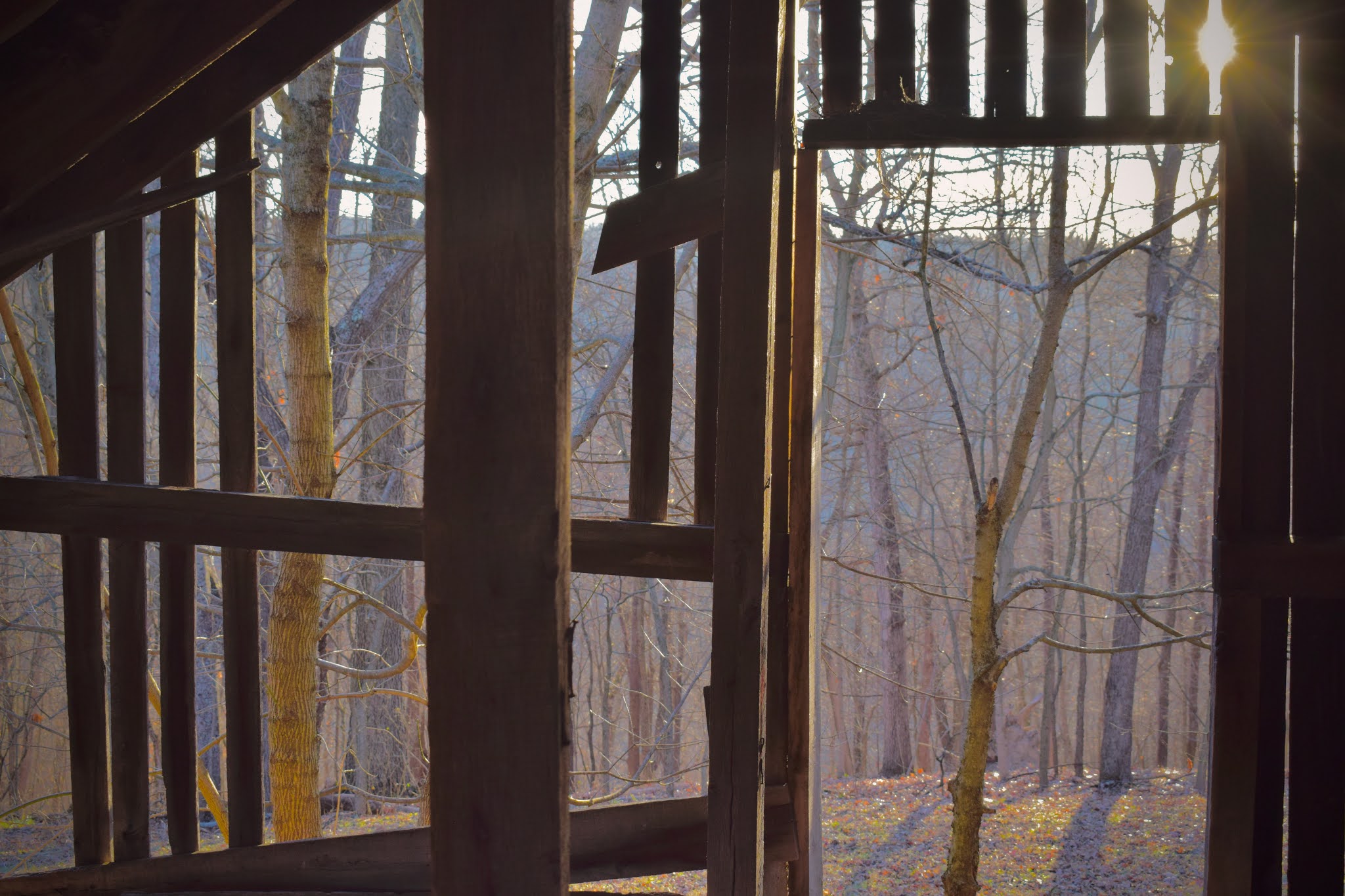
Looking out

 looking out the window with gratitude, facing west on Dec 18
Love God and keep the commandments (e.g., Deut 7:9*). Note the “and.” 
     Sometimes a vital doorway into life-more-abundant opens through re-reading; this requires letting go of previous interpretation/s and allowing a reincarnation to come into being, sometimes in a flash and other times much more slowly. To read “love” especially deserves frequent re-reading because it’s “many-splendored,” mercurial, sometimes shape-shifting with great speed and other times so slowly. In order to progress in living love, Paul suggests we advance beyond talking and thinking like a child (I Cor 13).
     I’m wondering if my spiritual life gets closeted, cutting off breath, by a semi-conscious belief that love for God enacts by (that is, “equals”) keeping commandments. While the linking term (“and”) might rarely mean “equals,” it usually points to something else. Of course keeping commandments is right and good, but I think that’s not enough when love is getting minimized. And I’m pretty sure that commandments can be followed without love. Responding to the voice, “Do it because I said to!” comes to mind.
     This blunt version (Love God by keeping the commandments) may be needed for childlike understanding; but, importantly, a more mature statement adds: “And you shall love the Lord your God with all your [mind and] heart and with your entire being and with all your might" (Deut 6:5); re-stated in the gospels, "And He [Jesus] replied to him, You shall love the Lord your God with all your heart and with all your soul and with all your mind (intellect)." (Matt 22:37, Amplified Bible Classic Ed.). 
     These scriptures stand out because they capsulize an essence. Ecclesiastes 12 expresses the heart of the matter similarly: 
All has been heard; the end of the matter is: Fear God [revere and worship Him, knowing that He is] and keep His commandments, for this is the whole of man [the full, original purpose of his creation, the object of God’s providence, the root of character, the foundation of all happiness, the adjustment to all inharmonious circumstances and conditions under the sun] and the whole [duty] for every man. (Amplified Bible Classic Edition).
     These pondering have been prompted in part because I’ve been wondering about the “eye of the heart.” Once again, Rumi (Mathnawi, Book V, line 1103, Nicholson’s translation**)
هست آن پیدا به پیش چشم دل  ** جهد کن سوی دل آ جهد المقل (But) that (difference) is manifest to the eye of the heart (spirit): exert thyself, advance towards the heart (spirit) with the exertion of one whose means are small.
     I’m surprised by the results shown on my computer screen when I enter “eye of the heart” because it immediately shows a book title by Frithjof Schuon: The Eye of the Heart. As mentioned in previous blogs, I’ve been reading in his book The Transcendent Unity of Religions but didn’t know of the one titled “The Eye of the Heart.” In searching another of his books on my shelf (Gnosis: Divine Wisdom), I find:
When Christ—in renewing the Law of Sinai, which he came to “fulfill” and not to “destroy”—teaches the love of God, he distinguishes between “heart”, “soul”, “strength” (Torah: “might”), and “mind”; this “love” thus excludes no faculty that unites with God, and it cannot be merely one term of an opposition, as when love and knowledge confront each other. If by the word “love” the Torah and the Gospel express above all the idea of “union” or “desire for union”, they make it clear by the adjectives that follow that this tendency includes diverse modes in keeping with the diversity of man’s nature; hence it is necessary to say, not that love alone draws toward God, but rather that only what draws toward God is love. (p. 83)
     Coleman Barks chose for today, December 18, from Rumi one he titles “What Is Love? Gratitude.” The poem concludes: “Don’t ask what love can make or do./ Look at the colors of the world./ The riverwater moving in all rivers at once” (A Year with Rumi). 
 looking out the window facing east a few days ago, with gratitude

* Deut 7:9 ISV “Know that the LORD your God is God, the trusted God who faithfully keeps his covenant to the thousandth generation of those who love him and obey his commands.”
Eccl 12:12-13 ISV: “There is no end to the crafting of many books, and too much study wearies the body.  Let the conclusion of all of these thoughts be heard: Fear God and obey his commandments, for this is what it means to be human.”
Qur’an 2:165 “But those who believe are more ardent in their love of God” and see the commentary in The Study Qur’an. See also Q 3:31 and commentary.

** Line 1103 can can be seen online: http://www.masnavi.net/1/10/eng/5/1100/ . For expansion of the “heart,” see also the preceding section, especially around line 1065. 

Friday, October 27, 2017

Polishing the Mirror for Revelation


"make a practice of polishing, polishing, polishing"


The early-morning reading from Rumi’s Mathnawi provokes more reflecting on reflection with his metaphors of the mirror we make. 
… make a practice of polishing, polishing, polishing,/ That thy heart may become a mirror full of images…/In order that the forms of the Unseen may appear in it, and that the reflexion of houri and angel may dart into it . . . [Mathnawi, Book IV, lines 2469-, Nicholson's translation]
Polishing the mirror is such a similar motif to the porch-project. Stage three, the application of Transparent Waterproofing Wood Finish, was interrupted by rainfall and by a week-long trip; but when the wood planks of the deck had time to dry out thoroughly and polishing was done, their surface opened a view into the inner grain. 

Whether mirrors being polished or veils being removed, a life-work offers transcendence. So many windows, or doorways, unmuddy-ing waters, smogfree-ing skies… all such cleansing pushes a person into the mystery of revelation. I love looking into the inner flower or the deeper woods because they draw me further, yet further into the unknown. A swirling fog does it too. 

And Love itself. Falling into it, adolescently, paints a fantasy, like a fairytale coming true, a gift-giving glimpse of this world swirling into the other. And then, for me, becoming-a-father especially threw open a trapdoor with no bottom, prompting wonderment into a forever-expanding Reality. Now getting old and older, the light draws me on, more certain of the truth beyond, through the veils of this world.
Clear mirror, no rust. I am the burning core of Mount Sinai, not a mind full of hatred.
I taste a wine not pressed from grapes.
The one everyone calls to . . .
                Coleman Barks' version, from Oct 27, "I Am Not," in A Year with Rumi

Thursday, October 12, 2017

The Woods; the Grain


Signs of two directions, two worlds, the outer and the inner, exoteric and esoteric. And the bridge between. Where and how does a person find spirit? For me, it’s like this: looking into the outer, going inside for the unique grain, the symbolic fingerprint, playing into the crossing, purifying, polishing, praying. It’s dedicated and reflected engagement of the kind I’m finding and making in this back-porch project, part two.

Why this fascination, some might say “obsession,” with realizing symbolic activity in what could be taken as simple matter? In this case, what’s the value of elaborating on the grain and knots in a plank of wood in the decking? Why photograph and write about this? Why connect it with spiritual text?
To respond, I might first step back to firmer footing. The broader question begins with the sense that cues importance: when is anything worth doing? Given limited time and other resources, where is the “go” signal (as well as the “no”) that guides selection and engagement. While doing the pro/con chart can be helpful, I’m relying more on an almost inarticulate sense; maybe the cue comes in the language of the heart. The best way I know to explain is through examples:
1. I’m convinced that enthusiasm tops the chart of Good Teaching. Although my certainty could be contested, about five decades of personal experience in teaching convinces me; this is also reinforced by reviews of published research on the study of teaching. 
2. I’m also convinced of the importance of resonance as a key to teaching with stories. When a person feels the resonance between a story and his/her inner being, a signal is presented saying: This is the place!  
3. In midlife, I discovered the need to invest in experiences with horses. When I’d find myself sorely in need of revitalization, I learned to spend the time and money for natural horsemanship because it provided energy for the physical, mental, and other demands of life.
The three cases point to sensing the source for vitality. Stories sometimes call it the water of life. Concerning the back-porch project, I was very surprised that this dreaded task offered a water-of-life opportunity. It was a doorway or bridge that I could easily missed. Sometimes the signal is very subtle and this one presented in a blip of fascination. I recognized a slight zing that had sufficient affinity to the scent of the water of life I’d learned to trust in cases like the three named just above. Following the invitation, I invested more willingly and expectantly as I cleaned the wood plank, then photographed the knots in appreciation of their beauty, and further explored this phenomenon as a symbolic bridge between the mundane and the divine through readings, meditating, and writing. 
The whole back-porch-project thing gives me a stepping stone for stretching toward a dream. I’m aware that I may be “off” and that I might come to realize I’m going the wrong way on this. That’s ok because then I’ll try a different approach. The dream/goal is to move further into the Real. I’m treating the back-porch project as a practicum for teachings such as those in Corbin’s Alone with the Alone. From this, for example, the almost invisible bridge between the worlds comes more into view; and I’m building understanding of how the act of interpretation (hermeneutics) makes the bridge.
when a thing manifested to the senses or the intellect calls for a hermeneutics (ta’wil) because it carries a meaning which transcends the simple datum and makes that thing a symbol, this symbolic truth implies a perception on the plane of the active Imagination. The wisdom which is concerned with such meanings, which makes things over as symbols and has as its field the intermediate world of subsisting Images, is a wisdom of light (hikmat nuriya), typified in the person of Joseph, the exemplary interpreter of visions. (page 190)
Corbin elaborates on the meaning and purpose of Active Imagination and takes my breath away with the connection to Story:
This imagination can be termed “illusory” only when it becomes opaque and loses its transparency. But when it is true to the divine reality it reveals, it liberates . . . The function [of Active Imagination is] effecting a coincidentia oppositorum . .  This manifestation is neither perceptible nor verifiable by the sensory faculties; discursive reason rejects it. It is perceptible only by the Active Imagination (Hadrat al-Khayal), the imaginative “Presence” or “Dignity,” the Imaginatrix) at times when it dominates man’s sense perceptions, in dreams or better still in the waking state (in the state characteristic of the gnostic when he departs from the consciousness of sensuous things). In short, a mystic perception (dhawq) is required. To perceive all forms as epiphanic forms (mazahir), that is, to perceive through the figures which they manifest and which are the eternal hexeities, that they are other than the Creator and nevertheless that they are He, is precisely to effect the encounter, the coincidence, between God’s descent toward the creature and the creature’s ascent toward the Creator. The “place” of this encounter is not outside the Creator-Creature totality, but is the area within it which corresponds specifically to the Active Imagination, in the manner of a bridge joining the two banks of a river. The crossing itself is essentially a hermeneutics of symbols (ta’wil, ta’bir), a method of understanding which transmutes sensory data and rational concepts into symbols (mazahir) by making them effect this crossing./ An intermediary, a mediatrix: such is the essential function of the Active Imagination. ..The intellect (aql) cannot replace it. . . it [Active Imagination] is also the place where all “divine history” is accomplished, the stories of the prophets, for example, which have meaning because they are theophanies; whereas on the plane of sensory evidence on which is enacted what we call History, the meaning, that is, the true nature of those stories, which are essentially “symbolic stories,” cannot be apprehended. (from pages 188-90)
I think Corbin’s meaning of Active Imagination extends well beyond the work I’m doing with cleaning planks and entering a bridge to “beauty” through the engagement with knots. But this might be a bit of practice. I didn’t find a way to integrate authentic passion into my teaching in the first years or decades, and learning to ride in natural horsemanship extended far beyond those first lessons. But a person has to get on the horse. 

Wednesday, October 4, 2017

One God; many faiths

“… I’ve traveled through my history, /From certainty to mystery. /God speaks in rhyme and paradox…” Carrie Newcomer & Michael Mains “Leaves Don’t Drop They Just Let Go” 
     I grew up near a small town with 3+ churches of the Christian variety along the few blocks of the main street. As a child, I was taught and believed the two other than our own were going to hell and our mission was to save them. The exclusionary tactic might have purpose to keep children from straying, but there’s also a teaching about growing past childish things. I believe spiritual growth includes moving from “certainty to mystery” and accepting the humility invoked in paradox. (I’m also wondering if the texture of certainly can be reborn, but that’s another story.)
     I remember the day when JFK got elected and the sense of despair in our church because we feared Catholics took their orders from Rome. We each travel through our histories and maybe we’ve grown a bit more tolerant now, but distrust still pervades our nation. The religion of love can be hard to find.
     I cannot claim to understand why we have difficulty grasping a religion of love with “One God and many faiths,” but I have a few ideas and an awesome passage from Alone with the Alone. Perhaps a basic requirement necessary to advance beyond childish belief structures involves a capacity to engage paradox, in this case, the One and the many. We accept many roads to Rome; why not many pathways to God? 
     I suspect the difficulty comes in deeper emotional obstacles, especially 1) Fear and 2) Power:
1. Fear: When it comes to going to Hell, most of us don’t want to be wrong about God. Even if there’s no such thing as Hell or if it’s not all brimstone (whatever that is), still any risk-possibility runs high on the scary scale. So it’s comforting to have others alongside who are taking the same position (i.e., religion) about what is required to go to heaven. To take responsibility for working out one’s salvation without the confirmation of others is a hard thing to do. 
2. The Power thing probably starts off with parents taking care of children who need protection from danger. You must do a, b, & c; you must not do x, y, & z. . . and if you don’t, God will get you! The problem is that power is addictive. Both the “high” from controlling and the “security” of being controlled can be hard to escape. As just noted regarding Fear, going alone is difficult.
Unfortunately for #1 and #2, humans seem to be made as individuals, not as clones. To the best I can get it, my spiritual path requires and rejoices in progressing toward a closer fit with my unique God-given character and destiny. That’s a life-long pathway. Yes, we do have opportunities and responsibilities for sharing, and still ultimately, essentially, faith is a one-person fit. One God; many faiths.
This idea is far from original. Among the books gathered on my desktop at this time are Divine Love (Ed. by Jeff Levin & Stephen Post), Buber’s I and Thou, Nasr’s Religion and the Order of Nature, Marcus Borg’s The God We Never Knew, and God in Search of Man by Abraham Joshua Heschel. (I haven't read them all.) In his introduction to A Year With Rumi, Coleman Barks surveys a wonderfully wide range of “Disrepectable Unaffiliated Mystics, though most are not at all disreputable, and many are devoutly affiliated,” and he speculates that blasphemy “is in whatever insults the soul” (p. 7). 
As promised earlier, I especially find comfort and direction in teachings such as Henry Corbin’s interpretation of Ibn ‘Arabi (Alone with the Alone). The passage takes some careful reading as we should expect if we are to venture into the name and nature of “God”:  
God: “a word which each man understands according to his aptitude, his knowledge of himself and the world around him, or else it is a symbol for the form of his personal belief… Thus the faiths differ with the Lords, just as the Lords differ, although all the faiths are forms of the one faith, just as all the Lords are forms in the mirror of the Lord of Lords. . . it does not follow that the Godhead condescends with equal docility to all determinate beings; God is not limited to the manner in which He is epiphanized for you and makes Himself adequate to your dimension. And that is why other creatures are under no obligation to obey the God who demands your worship, because their theophanies take other forms. The form in which He is epiphanized to you is different from that in which He is epiphanized to others. God as such transcends (munazzah) all intelligible, imaginable, or sensible forms, but considered in His Names and Attributes, that is, His theophanies, He is, on the contrary, inseparable from these forms, that is from a certain figure and a certain situs in space and time. . .” [pp. 309-10, fn51]
The image of the God whom the faithful creates is the Image of the God whom his own being reveals, his own being revealed by the “Hidden Treasure.” Thus it is the Image of him who first imagined His being (created it, that is, revealed it to being) as his own form or Image, or more exactly his mirror image. . . the symbol of the Self. [p. 266]