Showing posts with label paradox. Show all posts

Sunday, April 13, 2025

Wonder-ing

Sunday, April 13, ~4AM

I’m wondering when and how I got nudged (catapulted?) into a recent focus (near-obsession?) around a theme that I’d as soon not be caught in and yet seem unable (unwilling?) to get myself out of. Although the phrase may be more confusing than clarifying, the gravitational source for this orbit (wobble? whirlpool?) seems to be around “the death of God.” Yikes! Some exploration of that phrase is forthcoming, so have patience but also abandon all hope for a satisfactory clarification.

While I recall a sense of being struck at some point when reading (probably on the essential and unequivocal crux of Christianity that must be known in the cross/crucifixion), I’m not finding a specific place or even the text that threw me into this “flow” and therefore splash about supposing that maybe this location/focus/muddle might be more like a crest of a wave that developed over the past year or so than that it happened in an isolated passage. And (staying with the water metaphor), my motion feels more as treading than like swimming with a purposeful, well-defined target in sight. Maybe a dimly-detected direction developed rather gradually as I was being drawn to read some seven books by Stanley Hauerwas, three by Don Cupitt, and five by Rowan Williams.

Whatev-ah, to borrow the summary term effectively voiced by younger friends. Perhaps that tone works because some things in life just refuse focus. Like that shape-shifting form that Odysseus wrestled, these moments (decades?) are not meant to be confined to one stable meaning or center. Still, a bit of review across the terrain/sea might add insight or at least ease frustration.

Moon Setting, April 13, ~6AM


Likely the most compelling writer over the past year has emerged as Thomas J.J. Altizer (1927-2018). In his “theological memoir,” Altizer offers one interpretation of the key phrase:

Why is it not possible to understand the death of God as occurring in the Crucifixion itself? Is the sacrifice of Christ not finally the sacrifice of God? Is this why the cross is the most offensive symbol in the history of religions, one wholly unique to Christianity, and yet profoundly resisted by Christianity itself, as can be seen not only in Christian theological thinking but in Christian art and iconography… Even Dante could not envision the Crucifixion, and when this first fully occurs in Western poetry in Paradise Lost, it occurs only through a revolutionary vision of both God and Christ, one in which an uncrossable chasm separates the absolute sovereignty of the Father from the humiliation, suffering, and death of the Son. This is a chasm that only deepens in the further evolution of a uniquely modern Christian vision. And when the death of God is first called forth in Western vision and thinking, in Blake and Hegel, it is inseparable from a pure vision or a pure thinking of the Crucifixion. Is not the very ultimacy of this offense a decisive sign of the presence of an ultimate faith? Is a truly profound offense possible apart from the depths of faith? Is not an ultimate offense only and wholly within? pp. 106-7 in Living the Death of God: A Theological Memoir by Thomas J. J. Altizer, 2006 

Altizer’s synthesis of his own work is stated: “my deepest theological goal eventually became one of discovering a coincidentia oppositorum between [Satan and Christ]. Elaborating on this, Mark Taylor comments in his foreword to Living the Death of God:

It is important to understand that the ‘coincidence’ of opposites is not the ‘union’ of opposites. When opposites coincide, they are not reconciled but juxtaposed to create a tension, which is simultaneously the most profound suffering and its overcoming. As Altizer’s thinking matures, he comes to understand this passion in terms of the death of God. Far from an abstract philosophical concept or literary trope, the death of God is, for Altizer, an actual historical event first enacted in the person of Jesus and then actualized in the course of history, which culminates in the ‘absolute abyss or total darkness’ of modernity… p. xiv

A search for meaning in this “abstract philosophical concept or literary trope” requires considerable willingness to enter the expanses of paradox, parabola, mystery, and suchlike. While wading/sinking into the depths of “the death of God,” I’ve also found it helpful to move back and forth into “fiction,” particularly the novels of Walker Percy, and across into theology, especially the work of Altizer. Helpful also is interpretation of Altizer’s work offered by his colleagues: Lissa McCullough (e.g., her chapter “Theology as the Thinking of Passion Itself” in Thinking through the Death of God: A Critical Companion to Thomas J. J. Altizer; and Robert Detweiler, Breaking the Fall.

Altizer affirms the importance, the vital necessity, of the role of literature and art in our moving forward.

I found that it was literary scholars who were most deeply unveiling this [‘that ultimate crisis which had become our destiny, a crisis shattering modernity itself, and therefore dissolving modernity’s comprehensive negation of theology’], discovering in our most profound literature a religious or ultimate vision that is simply inexplicable through our given theological categories… p. 24, Living the Death of God.

Sun Rising, April 13, ~7AM

As noted above, reading Walker Percy’s novels provide a very helpful weaving from the theological into the fabric of life. For example, in Second Coming, the protagonist searches for God traumatic experiences of suffering, physical/mental/emotional illness, death, and suicide.  In particular, he struggles in knowing the names of “death” (pp. 272-3) and in confronting the ways people seem to be “living death” (p. 324). 

Altizer’s work also contributes to finding peace and presence of the divine even in the times when we feel abandoned:

…the very disappearance of God, or the pure invisibility of God, could make possible a total presence of God. [Monet , Water Lilies… only seen with pond  totality… we can only see these paintings by actually seeing the pure emptiness of God, for only that emptiness makes possible a seeing of the invisibility of God.

    Nor is there even an echo of a mysterium tremendum . Now every mysterium tremendum is absolutely silent and invisible, and only thaat invisibility and silence makes possible such a pure mysterium fascinans , a mysterium fascinans which here undergoes an epiphany as totality itself … an epiphany of the sacred, and perhaps most so because it is not an epiphany of God. Is this a genuine  coincidentia oppositorum of the sacred and the profane, and one in which both the sacred as sacred and the profane as profane are dissolved, or in which each fully passes into the other… Thereby we actually see a pure moment of incarnation, and a moment which here and now is all in all, so that now Earth itself is actually paradise, and paradise in this absolutely joyous moment

(pp. 80, 81, Living the Death of God.)

Morning, April 13


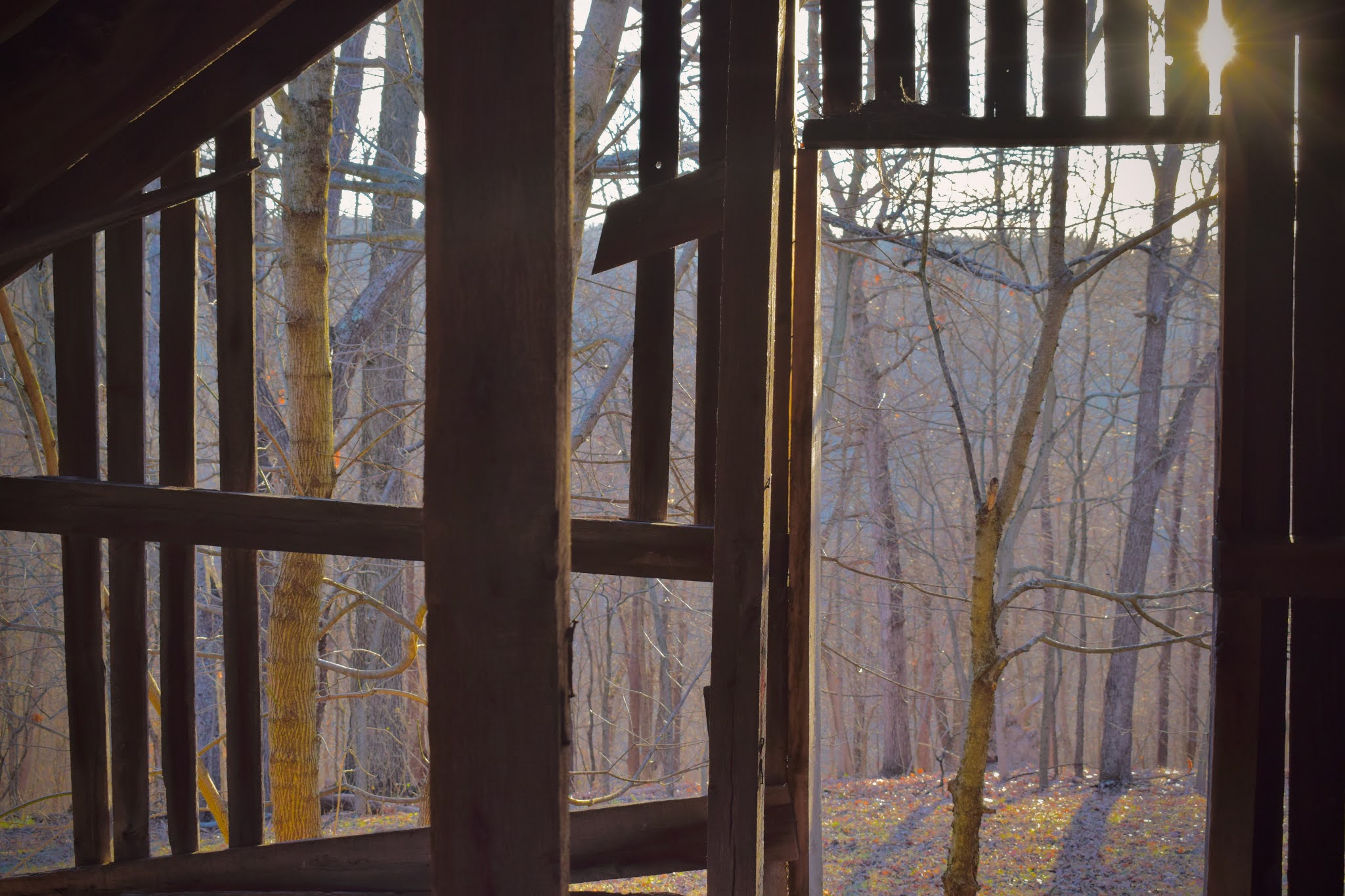
        I think this has something to do with my attraction to photography of Nature and the editing that moves toward the invisible. For now, let’s close with a sense of opening:

While ultimately faith is a gift of grace, humanly it is an ultimate struggle, and the absence of struggle can be understood as an absence of faith, but the struggle itself can only be a truly individual struggle. Hence this is a struggle transcending any possible guidelines or rules, and wholly inseparable from one’s unique condition and situation.  (p. 155, Living the Death of God.)

April, full of Spring!


Sunday, February 16, 2025

Promised Land


                             Musing paths taken… Ones left behind … Wondering beyond… 
 
Sometimes alone, surveying the woods, a sense of things distills, and a hard chill penetrates—the social/political world appears to have gone so cold. Are people much less caring now? Is this freezing coming off a world of fear? Or of an icy emptiness that’s warning an avalanche of hate? Perhaps in the pain of life’s losses, folks who might once have been more tolerant of differences now lash out like an ice storm or like a sudden crevice made when hearts break. And eyes lose sight when hit by bitter sleeting wind—when dreams are disappearing and hope dimming.


Once, in a time remembered, the look-ahead viewed down into a promised land that glowed golden with scientific progress, with warm expectations of happy grandchildren, sure of sufficient material wealth to make it to the end. But now, it’s more a mirage that evaporates to nothing. Over the edge, prospects shimmer as a barren desert that’s threatened by financial insecurity, shattered homes, selfish lies, and environmental disasters. 
Such conditions are sometimes related to “postmodernism.” But attempting to make sense of that term often feels yet more mind-numbing, like wandering further in a fog. Rather surprisingly, I’ve found this postmodern heaviness to be eased by reading works that talk about “the death of God.” Hold on. Take a breath.


The phrase does not have to mean that there is no God. 
Instead, it may offer the shock that’s needed to break a frozen conception. Maybe our view of “God” got stuck, leaving behind a faith that’s no longer of the living God. A living God gives vibrancy and renewal. A living God nourishes capacities required in order to pass through the traumatic experiences of life. Stories of God’s people remind us again and again of individuals and groups who lost faith when their religion turned into idols, particularly when caught in the love of status, materialism, and/or power. 
Mark C. Taylor gives a condensation of the complex called “death of God.” His summary packs in too much to take in at once; but when read without expecting to “get it,” the overview may be helpful. Taylor writes regarding “Death of God theology,” God
“does not simply disappear; rather, a particular notion of God—more specifically, neo-orthodoxy’s wholly other God—dies in an act of self-emptying that issues in a realized eschatology that totally transforms the present. Borrowing Nietzsche’s description of the ‘moral God,’ who is the negation of the religious vision of Jesus, Altizer argues that the distant God of neo-orthodoxy is the contradiction of life, instead of being its transfiguration and eternal Yes!’. . . The death of the transcendent neoorthodox God is, therefore, the negation of the negation of life, which allows the true God of Jesus (rather than Christ) to be born anew.” 

[pp. 200-201 in Mark C. Taylor’s After God; Taylor quotes Nietzsche, “The Anti-Christ,’ from The Portable Nietzsche, ed. Kauffman, p. 585. He references Thomas Altizer’s Gospel of Christian Atheism as well as his History as Apocalypse and others. For elaboration on “realized eschatology,” see Altizer’s Contemporary Jesus, p. 61 particularly.]

Postmodernism can also be better comprehended when considered in the flow from classical (pre-modern) into modern and on to postmodern and by making comparisons and contrasts among them. Don Cupitt’s Creation Out of Nothing (1990) has helpful material.
We have three visions of the world to compare, classical, modern and postmodern. They are related as thesis, antithesis and synthesis. In the classical vision the world was God’s work of art, produced by God’s almighty Word. In the modern vision the world was constructed as a machine operating in accordance with general mathematical rules, a machine of whose workings we might gain complete understanding and control. In the postmodern vision the world is represented as our expression, our fiction, our communally-produced and ever-changing work of art. We need a new kind of religion for this new world, an objectless, abstract practice of life as expressive religious art (p. 195).

The contrast involves leaving the distant All-Powerful God Who gives laws that humans follow as prescriptions for getting to Heaven, shifting to a God (of the modern time) who guides His people to making a better world, and adjusting further on to the postmodern loss of control with its overwhelming ambiguity, paradox, multiplicity, and uncertainty. Cupitt elaborates on these world changes concerning religion and related across fundamentalism and mysticism. 
“Unable now to look either to the past for legitimation or to the future for justification, we are forced to find and affirm the meaning of our life in the here and now. 
… it must be insisted at once that this does not imply any mystical regaining of Presence in the present moment. On the contrary, there is no mastery of the presence of the present moment. We always arrive a little too late, just as self-consciousness always gets there too late. And there can be no going back on the realization that self-expression is death to the speaker, whether the speaker be the Self or God. I am my life, I am my communicative expression; but as I go out into language I lose my self-identity and become nothing but the many different things that people make of me. Like God, we are nothing unless we give ourselves. Our destiny is to give ourselves by going out into communication, but in so giving ourselves we lose control of ourselves. That self-giving is religion, is love, is God and is death.“ (Creation Out of Nothing, pp 147-8)
In his book written a few years later, Cupitt develops further the possibilities of religion moving into and beyond postmodernism:
“Will the religion of Being be a religion of personal salvation? The old religions promised to the individual person an eternal life and a perfected selfhood. The religion of Being cannot promise that much. It promises only two things—aesthetic joy and happiness in death. (p. 140, The Religion of Being, 1998.)

“Under the new order, things are rather different. Our lives are not pre-planned, and there is no hidden puppeteer pulling wires and managing the plot. Faith in Being feels subjectively very like an artistic vocation, or an addiction to writing. Creativity has become an habitual way of life. All day, every day, a bit of you is listening, waiting for it to come. But how does . . . ‘it’ … ‘come’? It comes when the words that have been whirring in our heads all day, and the various forces struggling for expression within us, suddenly click together. Just for a moment, it all ‘comes right’, Being comes forth and there is a moment of creativity. That’s it. That’s what we live for—the moment when Meaning and Being meet, and something new is born. Our own personal struggle for wholeness in expression has met with Being’s own forthcoming into expression. We are briefly one with Being, and we know what it is to be a son of God and an agent of Creation.” (p. 151, The Religion of Being, 1998.)
As we participate in creativity, Cupitt describes our expression as “fictionalism,” as the making and joining in the play of good stories.
“Now, in religion, I have no new dogma. I am teaching play, I am teaching fictionalism and holy-common religious humanism, and I am saying that the move to these ideas is therapeutic. We come at them on the rebound from the failure of the old quest for transcendence, for reality and for dogmatic truth. The quest, its failure, the rebound and the return into immanence and play have all to be constantly renewed: that is fictionalism. And the return from them into hold-common religious humanism—that is Incarnation.
(p. 141, What Is a Story?)


Saturday, March 9, 2024

On Chill Rain, Cutting, and Moving Inside


We celebrate, of course, the spring rains, especially when softly falling, slight breeze. We share into a deepened sort of joy, the kind taken down to sense life force even alike the newly opened daffodils bowing, bent into the crossed, lifeless stalks. Also, while reluctant to cut, some cheer comes through the movement inside. 


We might note some parallel here with Samuel Terrien’s Job: Poet of Existence. His introduction cleanly asserts the direction of the book. 

“The poet of Job did not attempt to solve the problem of evil nor did he propose a vindication of God’s justice. . . he not only takes his place among all those who suffer, fighting with the incomprehensible forces of evil in the noce oscura, but he also can speak to all sufferers an authentic word of comfort, begetting in them the virtue of serenity over woe. . .

And we who read Job may likewise find a gain in the loss of self-sufficiency. ‘As pain that cannot forget,’ wrote Aeschylus, ‘falls drop by drop upon the heart, and in our despite, against our will, comes wisdom to us by the awful grace of God.’” (p. 21-2). 


Terrien proceeds to take us through the entire text of Job, just enough commentary along with amplifications from scripture as well as contemporary literature, so that the Deus Absconditus, the ineffable, the mystery surpassing human grasp, eases somewhat through the mist, unsurprisingly by the grace of love. Thus, the touch of comfort, the enlightening of peace. The gift of this text can be sampled in a passage taken near the conclusion as Job, after so much talk and rebuttal, finally goes almost mute in response to the Voice proceeding from the whirlwind.

In the presence of the holy, Job could not speak. ‘To make the relation to God into a feeling is to relativize and psychologize it. True relation is a coincidentia oppositorum, an absolute which gathers up the poles of feeling into itself’ [Terrien, p. 242; quoting Maurice S. Friedman, Martin Buber, The Life of Dialogue].


Wednesday, February 28, 2024

Presence in “Time-Out-Of-Time”


Wondering, ah, well, to be more honest, I’m grumbling about recent fiction and the too-prevalent topsy-turvy trend. Authors seem to feel it necessary to skip around among narrators. Equally, if not more troubling, is the jump-around time. Too often I have to waste time scrutinizing the top of each new chapter checking for time indicators. Authors show no compunction about jumping forward or back twenty or a hundred years. In short, a reader can no longer trust today’s composer to keep time, place, or point of view! Writers flagrantly violate the norm of beginning-middle-end. Why won’t they start at the beginning and continue steadily to the end? Like life.   

Today

Or maybe that’s not life. And the fiction was/is that it ever has been.

Consider the experience of almost any hour: often it includes wanderings of mind/heart/soul, maybe even the body. Perhaps the development of consciousness progressively and selectively includes increased awareness and capacity for getting out of “now” (and without losing the invaluable ability to choose to “be here now”).  Maybe there’s significant value in those impertinent remembrances and wily imaginations that just take off into reconstructed pasts. Even the ones that don’t go back cleanly but instead overlap into fanciful possibilities play important roles. The authentic path-maker, even pursuing the traditional ways, continually prays for revelation on “Whose woods these are?”

Maybe old boundaries need to be muddied by this quagmire wonderland of “What If…” Eric Auerbach articulates this phenomenon with the term “figura.” 
“… the notion of the new manifestation, the changing aspect, of the permanent runs through the whole history of the word [figura]” (p. 12, “Figura,” in Scenes from the Drama of European Literature).
Being present to “now” has the paradoxical capacity to participate both from the prophetic past as well as to reverberate even into future, all this in deepening meaning to the self: inheritance and destiny.
Figural interpretation establishes a connection between two events or persons in such a way that the first signifies not only itself but also the second, while the second involves of fulfills the first. The two poles of a figure are separated in time, but both, being real events or persons, are within temporality. They are both contained in the flowing stream which is historical life, and only the comprehension, the intellectus spiritualis, of their interdependence is a spiritual act. In practice we almost always find an interpretation of the Old Testament, whose episodes are interpreted as figures or phenomenal prophecies of the events of the New Testament. Auerbach, Mimesis, p. 73
“Reality” thus composes of a hodge-podge blurring past/present/future, perhaps making life more bizarre than fiction. And, therefore, negotiating this almost crazy-making holds the key to charting the authentic pathway. Letting go of standard time seems to be closer to the guidance from the Source than the steady mind-marked realism with its predictable increments. 
Special care is needed lest the animating force of wondering disintegrate into aimless wandering. Attention needs to be devoted to evolving consciousness. Engagement with creative art involving evolutionary change offers continuing revelation. This work finds articulation in constructs such as Auerbach’s figura and Jung’s archetype. 
The God-given life force, both through continuing guidance and in renewed energy, comes in such dynamics that break through the tendency to get stuck in prescriptive literalisms and to flow with the reassuring testimony of ancestors. Let’s look closely into the subtle shifts in seasonal change, into the nuance of character development in our children as well as in the opportunities of aging, including anticipation of death.

Help in negotiating time out of time has come recently in reading Amos Wilder. In Jesus’ Parables and the War of Myths, Wilder talks about the radical shift: hero as lion or lamb, suffering as good or bad signal, loss as victory. The need for continuing care for the individual’s self understanding as well as for religious crises regarding changing social issues requires “a new creation” that fulfills the old and that can only find “adequate expression in a transcendental mythical statement. Yet such vision, though by its nature it dissolved ordinary relations of time, space, and causation, was nevertheless rooted in historical realities and could therefore later be translated and applied to ongoing circumstances” (Wilder, Jesus’ Parables and the War of Myths, pp. 151-152). Over a long period of time, good literature imitated this mythology. But then Jesus upset the prescriptions; and, consequently, interpretations and writers (and persons searching for an authentic pathway) found themselves in this “war of myths.” 
It is through images that all such orientation of the believer in an enigmatic world is conveyed. The world-understanding in question involves, of course, the heart as well as the knowing faculties… The new myth-making powers of the Christian movement meant more than an overthrow of rival myths and more than a liberation from letter and from law. It meant the portrayal of the real nature of things and of the course of existence as far as human speech could encompass such mysteries. Comparing lesser things with greater, we appropriate the myth and symbol of the New Testament by opening ourselves to its wisdom in the same order of response with which we encounter art or read poetry. Though this order of knowing is closer to that of ancient spell or visionary realization, or the world-making of the child, yet it is, for this very reason, a total and immediate kind of knowing and one that involves us totally. Wilder, Jesus’ Parables and the War of Myths, p. 127


Thursday, February 3, 2022

Winter Containment


While not a big fan of winter, this season perseveres in proving the value found in stripping down to the basics, the beauty revealed in moving toward the essence. Spiritual teachings stress the hard truth of suffering that is necessary in order to remove the superficial and to recover the True Self; for example, “die before you die,” “to thine own self be true,” and “He who knows himself (or his-self, his soul, his mind) knows his Lord.” The latter phrase is provocatively elaborated in an article by Dom Sylvester Houédard, “Notes on the More Than Human Saying: ‘Unless you know yourself you cannot know God.’” For example, he writes:

“The authentically Semitic act of gnosis (daath, yada ‘to know’) is always the fruitful experience of the one living God as Lord and so as obliging us; e.g. knowledge of God’s goodness to us imposing on us goodness to others. It is the certitude of faith fruitful in deeds; the knowledge that produces likeness and makes us like what we know, that deifies and makes us deiform.”

Houédard also links to the Creation and to “the essence prior to the creating word”:

“Whoever wishes to know the divine breath must first know the cosmos for he who knows himself knows his Lord who is manifest in him. (The ‘distress of the Divine Names at the non-manifestation of their effects’ prior to the creating word of command, is not only why the obligating command is for us to show the effects, but indicates that the divine and uncreated energies are themselves an eternal manifestation of the essence prior to the creating word: the former is developed by Eckhart, the latter by S. Gregory Palamas.)”

         Along these lines, Antonio Machado’s Llamó a mi corazón  has long been a favorite, memorized and often recited in Spanish and with Robert Bly’s English translation. The second end rhyme (viento/quiero) capsulizes the essential quest, the human/divine drama; and the entire poem radiates with images of the True Self. 

Llamó a mi corazón, un claro día,

con un perfume de jazmín, el viento.

 -A cambio de este aroma,

todo el aroma de tus rosas quiero.

Quiero translates as “want, wish, or love”; viento as “wind.” And as the ensuing lines tell, this wind speaks to the soul, calling to account for the tending of the garden: The human accountability for nurturing the divine spark poignantly noted with the longing for the aroma of the roses, the watering of the flowers, and heartbreak over the lost inheritance. As often shown in revelation, this wind carries the holy spirit, the breath of God, the communion to and from the Self.

     Like a compass needle, my directional finder points to “true self,” perhaps always, certainly as years advance. Far back in the beginning, only twenty-seven verses into the Good Book, we’re given our inheritance and destiny: “made in the image of God.” And yet, the currents of life confuse the signal system, or maybe the pathway back home takes threads of many colors, making the unique texture of each creation. 

In any case, the current clue that seems to be key to getting there comes in this teaching: “to know yourself is to know your Lord.” That magnetic pole star has been featured across religions and through varied major writers.

Readings resonate as soul guides, especially ones on gnosis/mysticism, suffering, and wholeness. As the season of winter draws inward, space has opened to engage volumes that previously seemed too demanding: C.G. Jung’s Aion, The Grail Legend by Emma Jung and Marie-Louise von Franz, Barbara Hannah’s Striving Toward Wholeness, and writings by St. John of the Cross, including Edith Stein’s The Science of the Cross.

The swirl, stirring up muddy stuff from the bottom, among readings, dreams, and weather, seems to compose in the effort and evidence of holding together opposites. Barbara Hannah writes:

“In the empirical Self of psychology, light and shadow form a paradoxical unity, but in the orthodox Christian concept the archetype is split into two irreconcilable halves…

This inevitably involves us in a crucifixion of the ego between these two irreconcilable opposites. Of course, there can be no final extinction of the ego, for that would destroy all possibility of consciousness. The ego has to submit, however, to a continual crucifixion between the opposites, to those dreaded conflicts in duty…" (pp. 28-28, Lectures on Jung’s Aion).

Sunday, January 10, 2021

Path-Maker Breaking Stones

"We make the road by walking," photo, January 9, 2021
The primary offering of a mystical text, in my experience, comes in the uniquely personal breaking open of the divine, often only as an elusive whiff at the edge of the articulate, a breeze that dares one to go beyond frozen thought patterns, to venture past traditions that violate the sanctity of freedom. And almost paradoxically, this freedom conjoins with unity, as Rabindranath Tagore told in his Nobel Prize Acceptance Speech: “We must discover the most profound unity, the spiritual unity between the different races…… He who sees all beings as himself, who realises all beings as himself, knows Truth.” This focuses the heart of Gitanjali, the force that Coleman Barks seeks to liberate and preserve.

        The beckoning pathway forms in glimpsing, in tasting the mystery that remains mysterious while also flavoring the everyday with a texture of life beyond. With this expectation, I looked forward to Fons Vitae’s publication of Coleman Barks’ “translation/version” of Tagore’s Gitanjali (Song Offerings). Having often found support in “making the road by walking” through Barks’ versions of Jalaluddin Rumi (which he fashioned from English translations by Arberry, Nicholson, and others), how would Barks enhance the vitality in Tagore’s own English translation from his native Bengali in the work which led to Tagore’s Nobel Prize award?

        In addition to the 103 songs comprising Gitanjali, Barks includes four additional poems from Tagore’s work, The Crescent Moon, and Barks also gives us a dozen pages of his own commentary and notes. I’d like an additional hundred pages of Barks’ commentary, and still I find that the concentrated material contributes by showing the involvement of W.B. Yates, Ezra Pound, and others as well as pointing to connections with Ghandi and Kabir.

        Barks begins, “Rabindranath Tagore is one of the great universal mystics.” Again, to me, the role of the mystic and thus of mystical text features access to the holy, so that the individual breathes the unique essence that purifies, inspires, and vitalizes, so that he or she moves forward on the pathway “made by walking” (e.g., Antonio Machado, in Campos de Castilla, Proverbios y Cantares, #29) and bridges “these daft twin brothers, life and death” (from Tagore’s #58, p. 76). Barks’ version, just cited, shows the light touch, which serves as a little wake-up invitation, in part through the addition of “daft” to Tagore’s English translation which reads: “the joy that sets the twin brothers, life and death, dancing over the wide world…” (p. 149 in Visva-Bharati/UBS Publication of Gitanjali). Barks also features, in the next line, “the storm” in a way that moves me differently from Tagore’s “tempest.” 

        It’s not that one translation/version is better than the other but that a force may be invoked to join the dance, to broker the mystical encounter. In Gitanjali, Tagore offers a departure from conventional religion. For example, number 11 opens:

“Leave this chanting and singing and telling of beads!

Whom dost thou worship in this lonely dark corner of a temple with all doors shut?

Open thine eyes and see thy God is not before thee!

   He is there where the tiller is tilling the hard ground

and where the path-maker is breaking stones…” 

     (p. 23 in Visva-Bharati/UBS)

Barks’ version goes:

“Give up this fumbling with beads, this chanting 

     in the dark, shut temple.

… A mason

     is breaking and laying stone for a path.”

      In number 102, Tagore, with beautiful respect for the individual’s responsibility and authority for path-making, tells of people who demand “Tell me all your meanings” and he responds, “‘Ah, who knows what they mean!’ They smile and go away in utter scorn./ And you sit there smiling.” (p. 253 in Visva-Bharati/UBS)

Barks’ version of the middle part of #102 offers, “A secret part of you flows out of me.” 

For me, the chance for a bit more of this secret is the offering from the publication of What Wants to Come Through Me Now. 


Wednesday, November 11, 2020

Winter Promises

Most years the advent of winter has evoked dread. Or, if and when approached in a spirit of surrender, it's inspired sighs, even commitment to long-suffering, a reluctant dedication to further the very important virtue of patience, to carry the hope of spring-coming. Yet often the chill in the air makes breathing out in those steam puffs. Perhaps they’re little smoke-signals asking permission to join the bears—how about hibernating until the world turns alive again? 

      But then this week late autumn’s falling, mostly fallen, leaves are sprinkling wonder. Today, as shown above, the woods’ opening increased witness of dawn’s beauty. And turning to the opposite western sky, a double rainbow arched to land both north and south, even before the rains arrive.


Yesterday the sun-lit woods, more bared to essence, showed a redbud reduced to a few leaves, looking like heart-shaped jewels were tracing out the bowing limbs in lines as graceful as ballerinas, almost weightless, defying gravity. Alongside it a young maple echoed the dance, yellow light against the dimmed exuberance of spring, the background of fallen leaves turning bronze and disappearing as if the superficial gives way, releasing the eternal.

      Instead of dreading winter, this year there’s an exciting sense of winter tracks wanting to be followed, the ones leading further into the “True Self.” 


Recent reading of Richard Rohr has prepared the way to welcome the closed-in season because it’s a time especially fitting for contemplation. In his book on the second half of life, Rohr explains how summer’s “loyal soldier” builds the container for a person’s winter work and how the soldier has to be thanked and dismissed.

“Paradoxically, your loyal soldier gives you so much security and validation that you may confuse his voice with the very voice of God. If this inner and critical voice has kept you safe for many years as your inner voice of authority, you may end up not being able to hear the real voice of God. The loyal soldier is the voice of all your early authority figures. His or her ability to offer shame, guilt, warnings, boundaries, and self-doubt is the gift that never stops giving. Remember, it can be a feminine voice too; but it is not the ‘still, small voice’ of God (I Kings 19:13) that gives us our power instead of always taking our power.

The loyal soldier cannot get you to the second half of life. He does not even understand it. He has not been there. He can help you ‘get through hell,’ with the early decisions that demand black-and-white thinking; but then you have to say good-bye when you move into the subtlety of midlife and later life. . .

There is a deeper voice of God, which you must learn to hear and obey in the second half of life. It will sound an awful lot like the voices of risk, of trust, of surrender, of soul, of ‘common sense,’ of destiny, of love, of an intimate stranger, of your deepest self, of soulful ‘Beatrice.’ The true faith journey only begins at this point…we have a container strong enough to hold the contents of our real life, which is always filled with contradictions and adventures and immense challenges. Psychological wholeness and spiritual holiness never exclude the problem from the solution. If it is wholeness, then it is always paradoxical, and holds both the dark and light sides of things. (pp. 46, 48. Falling Upward; emphasis in original)

The passage invites return and deeper engagement in the resources such as the Mystical Languages of Unsaying  and to the Beloved, the stories of Layla… and forward into The Cloud of Unknowing and others.  Also, Rohr points particularly to Thomas Merton for guidance, especially to his New Seeds of Contemplation. Merton also reveals tracks on the pathway including those of St. John of the Cross and in his translation/versions of portions of Chuang Tzu. In his introduction, Merton writes: 

“The key to Chuang Tzu’s thought is the complementarity of opposites, and this can be seen only when one grasps the central ‘pivot’ of Tao which passes squarely through both the ‘Yes’ and ‘No,’ ‘I’ and ‘Not-I’ (p. 30). A sample appropriate to the forced inactivity of winter:

“… No one seems to know

how useful it is to be useless.”

The Way of Chuang Tzu, p. 59

These guides join others who teach and inspire in the way to the Beloved, the pathway home. This winter promises opportunity to re-trace ground turned years before, intent on deeper reflection. For example, these lines noted in last year’s autumn are calling:

“When the servant comes to know himself, thereby knowing God, he does not know God in Himself. Rather, he knows Him as his own Lord. This is the God who discloses Himself to the soul, and the self-disclosure is different from that experienced by any other soul. The God that I come to know through knowing myself is the God of my own belief, the water which has assumed the color of my cup.” William Chittick, Sufi Path of Knowledge: Ibn al-‘Arabi’s Metaphysics of Imagination, p. 344 (cited in Light Enough, Sept 24, 2019).