Showing posts with label leadership. Show all posts

Sunday, October 29, 2017

Over-Wintering

 
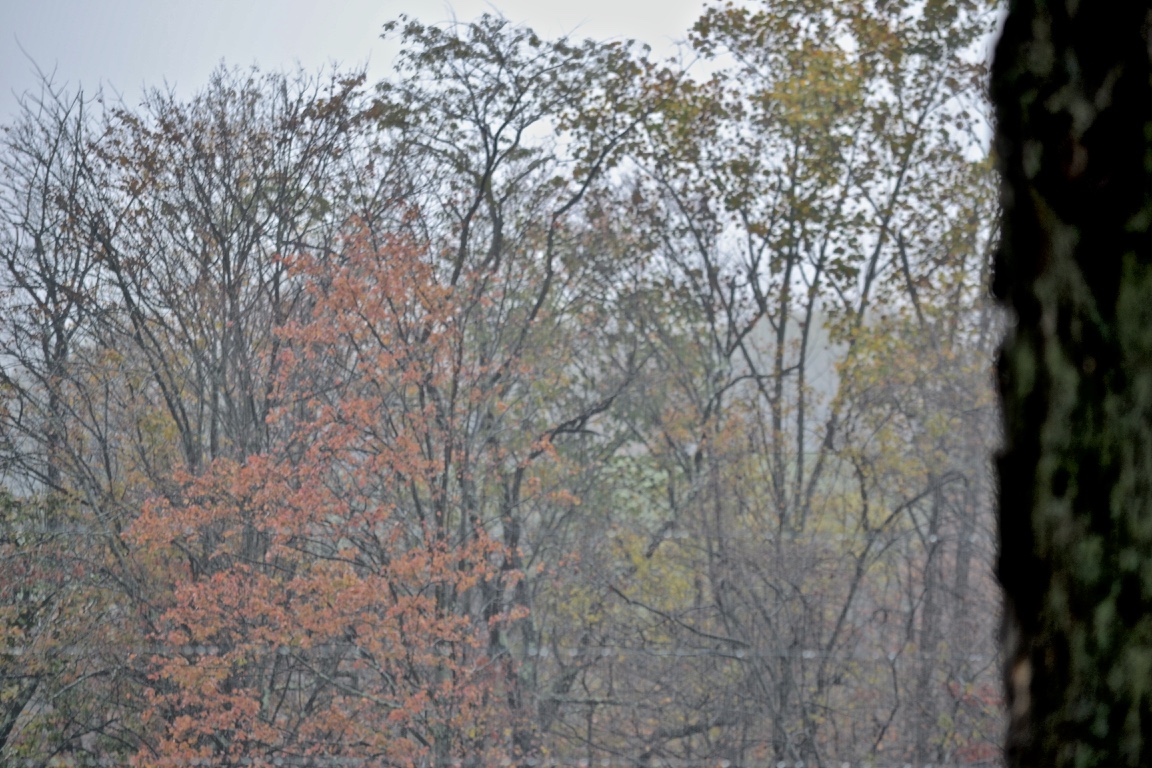
 Of course we love the sunlit afternoons, brilliant, dazzling, reassuring; and yet this morning’s slowdown drizzle carries an integrity calling: look closely, appreciate, care for the lichened branches in the muted pastels, too. 


The crow caws overhead into the chimes, and the raindrops patter, and nothing’s so important as it was.


Rain falling on garlic bed
We’re thankful for the blessing on the one-hundred forty-four garlic cloves nestled under two inches of amended mulched soil in yesterday’s planting. Seasoning. Medicinal. Over-wintering.


Maria Popova (BrainPickings) quotes from Ann Hamilton’s essay titled “Making Not Knowing,” adapted from her 2005 commencement address at The School of the Art Institute of Chicago.
“Our culture has beheld with suspicion unproductive time, things not utilitarian, and daydreaming in general, but we live in a time when it is especially challenging to articulate the importance of experiences that don’t produce anything obvious, aren’t easily quantifiable, resist measurement, aren’t easily named, are categorically in-between. . .It is the task of the artist to make material form, to give it presence, to make it social; it is the task of the artist to lead the leaders by staying at the threshold; to be an unsettler . . . "

Thursday, May 25, 2017

Love Inseparable from Justice, Mercy, Compassion


5 AM-ish is the perfect time for coffee, especially on May 25, 2017, when the world turns sepia-toned, the tin roof echoes the gently falling rain, the robin joins in, not exactly singing but offering unabashedly itself. And the Amish-made rocking chair on the back porch, along with the man in it, creak just a bit. 
     Most Thursdays for the past decade would likely have found me at Starbucks when the door opens, 5AM, often the one on the corner of the Beltway and Route 1, pondering matters academic, like everybody else, wondering. Whatever: how we got here, how to get out without completely betraying the soul. 
     I don’t think humans are born nice and we’re not born mean either, but it sure looks like it. There’s a book within reach of my desk called Just Babies, mostly not-yet-read, but the point is that we’re born, at least most everybody is, with a capacity to prefer goodness and even with discernment of good guys. Just—as in born-with justice. Even before speaking or walking infants can choose the person who was nice, looking away from the actor who meanly stole the toy from another child, preferring the one showing love.
     What happens? How can so many people fail to see corrupt wanna-be leaders who are going to betray them without batting an eye? How can folks choose to watch a network spewing lies and hate? And then go to church, even send missionaries! The good book, just about any of them, warns of this. Freedom, this gift given humans, means suffering and most would rather not. The textbook we used in Good Stories preaches reciprocal altruism and asserts the necessity of imposing disincentives even to persons who collaborate with and who do not resist the evil-doers.
     Other good books teach purification. The person who wants to stone the one caught in adultery is not to be hated or vilified. The resistance needs to come from a clean heart because harboring hate destroys. So the person who committed the horrific hate crime on campus, the persons who support a power-crazed politiican, those who maim horses to win competitions—all these should be stopped but best not by those calling them nasty names. 

     Somehow love is still the answer. And it must be a love greater than we have grown, one inseparable from justice, mercy, compassion.

Sunday, March 5, 2017

From Garden Dark to Beautiful Beasts


Karen Armstrong opens her consideration of Genesis not with the Garden but with an exploration of Jacob’s wrestling because that’s the model for our engagement with divine revelation. We have to yield to the struggle of imagination and surrender our craving for arrogant certainty. The window into that which surpasses, that which includes love and hope, opens of necessity by parable, by likeness; how else can we see into that which is greater than immature sight? And it’s in narrative, in good stories, that we practice the work/play of parable. Armstrong says:
“The biblical authors force us to make an imaginative effort. They imply that it is a hard struggle to discern a sacred reality in the flawed and tragic conditions in which we live and that our experience will often be disconcerting or contradictory. Like Jacob, we will have to wrestle in the dark, denied the consolations of final certitude and experiencing, at best only transient, elusive blessing” (In the Beginning, p. 6).   
As noted in the previous blogMartin Buber urges us to re-see the biblical narratives so that we experience continuing revelation. It’s like learning to see in the dark, in what has become dark due to repeated looking without seeing further. Without the active searching advocated by Armstrong and Buber, the light goes out; or perhaps our doorway, our capacity to see, closes when we fail to exercise the gift. 
Christian teachings call for maturity: “put away childish things” (I Corinthians 13); and the teacher demands that we advance in understanding of parable (e.g., Matthew 15). Maturity in understanding shows up in “steadfast love, justice, and righteousness” (Jeremiah 9:24). If sacred text such as the Qur’an contains multiple layers of meaning, and it does, how do we learn to see further? 

I believe that our work/play with good stories builds capacity. For example, our literary inheritance offers many fabulous tales on the beauty-and-beast theme. A first level of experiencing these stories usually has a magical transformation in which the beast changes form, as when a kiss breaks an enchantment and the frog turns into a prince charming. In the “Marriage of Gawaine and Dame Ragnell,” upon the knight’s kiss the hideous woman is then seen as the most beautiful maiden.
But if we learn to penetrate to a deeper understanding, we might begin to glean from the texture of relationship shown in the tale. When might realize that in true allegiance between knight and ruler as well as between beloveds, only when persons incarnate sovereignty is the vision gained to perceive the higher level of beauty. We recite easily the bromide about “only skin deep,” but do our footsteps follow the divine when they beckon beyond our comfortable materialism? Can we attract leaders with vision of compassion? We might begin to see as ugly  instead of attractive our own desires as well as other persuaders who value appearance, riches, and worldly fame. 
Our spiritual and literary inheritance tries to guide us. After Nasrudin is shunned at the banquet when wearing shabby clothing and then honored when he returns fashionably attired, he puts the food in his jacket pockets while saying, “Eat, coat, eat!” In response to his shocked host, the teacher replies, “It’s my coat you welcomed to the feast, not me.”
Since Adam and Eve left the Garden, we’ve been destined to journey in the shadows of the tree of knowing good from bad. When Psyche left the castle garden to go in search of Love, she had to develop capacity to see in the dark. Her naïveté prevented her from seeing the treachery of those she presumed to love her. Her footsteps led her over and again past her failures to see. She had to learn to look with the vision of belief and to trust the resources coming from the divine source. That’s the stuff of sovereignty. It’s developed step by step, task by bigger task. And often enough, we’ll feel defeated, especially as Rilke translates Jacob’s wrestling into our choosing to engage “constantly greater beings."
Back to the “Marriage” story, Gawaine also models the progression. He proved the nature of service, trusting the leadership of the authentic rule, looking beyond the superficial that was labeled “ugly” by material, habitual, conventional sight. He leaned into the divine relationship, and on into the kiss that is made when one acts not for worldly praise but for the Word. Then the eyes open to see further into truth and beauty.


When we grow stronger in translating good stories and parables, when the Word lives in our politics, our work, and our inner being, then we gain capacity to see further in the dark, step by step into the light.

Saturday, January 11, 2014

Fog in Mid-Winter


     Perhaps being in a fog isn’t all bad. Or maybe it’s about coming of age in the late ‘60s and now living into the far side of my own 60s that loves the oak leaves more gold in mid-winter than in lush summer or even in autumn’s splendor.  Fire. Ashes. And what’s passed through.


     The grey fog.  Sepia. Subtleties.

     It could be in the hint of a pathway into the damp grey, not so far away, and yet teasing past vision’s presumption. It’s in a quality of light beyond the silhouetted knowns.  And the presence of some who’ve already ventured there.


Thursday, October 31, 2013

Taking Literacies Back to Experience


   Each week in our Good Stories course we engage a favorite tale of mine with the selection determined by my sense of which one promises to advance our effort to compose destinies that promote peace and justice.  An early theme develops the “water of life” as the source of vitality and renewal needed for this quest.  The search for the renewal of life takes us to the dangerous ground suggested by our primary text, Brian Boyd’s On the Origin of Stories.   His subtitle points to three troublesome critters along this journey: Evolution, Cognition, & Fiction.  The question directing our path asks: How can the stories we tell and produce advance consciousness so that our inner and outer worlds increase peace & justice?


   Persons who dare approach the edge of consciousness best go prepared.  This week’s Good Story tells of Arthur, the King, entering the deep woods at that edge and being confronted by the ugliest creature even seen.  That’s what ebbs out of the unconscious, the primeval swamp where new meaning evolves shape-shifting, grotesque yet potentially gorgeous. 

   Surprise, surprise—Guess what?  This isn’t pretty to the hegemonic powers that be.  Today I travel to Tucson for my professional development and the university questions my choice.  Having considered the options of going to the traditional annual meetings of professional organizations, I decided instead that Zen Mind, Zen Horse has more to offer toward my teaching and research.  Knowing Arthur’s tale, why should I be surprised that the workplace questions my choice?  The Good Stories have warned me over and over: expect to be challenged when you venture to the edge.

   After an initial exasperation, I realized the challenge is good because it invites pulling the elephant out of the closet for persons who can’t yet smell it.  Think of the elephant as concrete experience and the room as symbolic representation.  School rooms too often act as if representations (e.g., literacy or letter-making) exist apart from the real world.  For example, classes study dystopian literature without first and repeatedly claiming the primacy of authentic real-world constructions that are growing within the individuals and their communities.  Another example that bothers me: teachers model and students are allowed to grab Google images for their digital media productions instead of constructing their own representations. To strangle literacies from experiences is an act of violence, harshly disrespectful of each person’s right to author and voice.


I choose Zen Mind, Zen Horse because it returns literacy to authenticity through hands-on engagement with horses, coached by persons (including a neurosurgeon horseman and a doctor in psychology) who recognize that “our left hemisphere, armed with its overwhelming power of speech, remains wary of its reticent, emotive, and mute counterpart on the right [hemisphere of the brain]” and that “the horse also shows us the joy that comes from living with the bare truth of our selves” (pp. 6, 287 in Allan Hamilton’s Zen Mind, Zen Horse).
    
  Good Stories is part of the University’s I-Series program where tending to Big Questions are prominent.  Our course connects literacy with meaningful personal and social change.  To do this, students learn to work with stories across four levels of explanation.  Brian Boyd develops these as universal, local, personal, and particular.  We elaborate the universal level by finding resonance with archetypes in traditional tales (cf. Marie Louise von Franz, Interpretation of Fairy Tales).  As indicated in the subtitle of our course, Teaching Narratives for Peace & Justice, the construct of power takes center stage.  Across time and literature, the horse best provides the source for understanding the archetype of power, as evident in the term, horsepower. 


   My research informs the fundamental connection of literacy with meaningful pro-social personal and significant organization change (that is, peace & justice), and it comes in expanding my experience with horses and in the subsequent articulation of those experiences into courses like the Good Stories class and programs like Reins of Power that I have provided for teachers on several occasions. 

   That’s a brief on how the Zen Mind, Zen Horse program informs my work in literacy education, and it suggests the direction I think professional development needs to head.  While I don’t expect many educators will find their way to a living horse, I’m encouraged with the emphasis given to the Maker Movement and how it’s infused into prototype opportunities such as the Connected Learning MOOC featured by the National Writing Project this past summer.

Happy trails, y’all.

Wednesday, October 23, 2013

Morning Fire


October 23, 2013.  
Overnight low temperature upper 30s.  
Definitely cool enough for building a 5AM fire in the wood stove. 
   My fire-starting skills are pretty good: dry twigs over a crumpled half sheet of newspaper, loosely arranged in a sort of lean-to against split maple or oak, plenty of circulation space.  A single match almost always suffices to initiate a cheerful, warming blaze; but this morning, after the third attempt with lots of smoke, only smoldering sticks filled the firepit with more smoke.  It’s like the chimney’s blocked, I considered; and then a thought flickered by: check the control for airflow.  I always leave it wide open but just maybe it wasn’t.  Somehow it had been moved all the way down!  When I ran it full throttle, the fire leapt like a pent-up horse loosed on the range. 
   An Emily Dickinson poem flickered to mind: “the horse that scents the living grass/will be restrained with a shot/if at all.”  Not sure about “restrained” but it goes something like that.
   My thoughts also still simmered with the meeting yesterday afternoon with teachers at Hickory Elementary about blogging, about making our heart maps that stir up the fire for teaching, about connected learning that brings in the airflow of public spaces, making relationships with like-minded pros, with tuning into the joy of expression.
   What is it in this metaphor of fire starting that wants to ignite our sometimes-darkened classrooms?  In my college class yesterday, we looked at the tendency of any culture or any individual to seek out confirmatory information and to suppress stuff that might make wildfires.  How has the airflow of exhilarating inspiration been shut down, probably without us even knowing the gate onto living grass waits right at our fingertips, perhaps where we see only walls.  Like the high-stakes exams.  Like the way things have been.  Like the curriculum that has to be covered.  More smoke.  Dulled out eyes.  Crumpled drafts of worksheets, asbestos prompts, irrelevant readings, mandated assessments. 
   We can keep striking matches but the fire of inspired learning cannot blaze up until we open the shutters onto the free range and let the airflow from authentic passion rush through.

P.S. I’m realizing that one way I almost unconsciously leave the airflow shut down happens when my morning begins with checking email, tweetdeck, facebook, latest scores, or morning news.  Rumi’s breeze at dawn and predawn musing off the breath of dreams get stifled by such externals.  I promise myself to love inspiration above the ease of mediated stuff.  I promise to start my day respecting Life.

PPS. Emily’s poem:        
The Life that tied too tight escapes
Will ever after run
With a prudential look behind
And specters of the Rein—
The Horse that scents the living Grass
And sees the Pastures smile,
Will be retaken with a shot

If he is caught at all—
                                    

Sunday, June 30, 2013

The Revolution of PD, Avatars, & MOOCs

Collage of pages from CLMOOC
Avatar.  The entry of that term into my lexicon remains hazy, but it probably traces back ~15 years to a dystopian maze of overheard snippets between two teenagers about videogames and RPGs.  Even when given admission to the cyberworld, I didn’t get it.  The computer screen filled with violent action and multiple lives while the human's eyes transfixed, his body contorted, inert except for thumbs jabbing a little black box with red and yellow buttons, maybe a white one.  The controller might have been jammed into my hands briefly just as some alien form zapped up the “avatar?”  All this orchestrated with electronic screaming.  It was like an underwater nightmare with me, avatarish, almost imploding, starved for air.

My inarticulate prayer then must have been: Please transport me to a real-life riding arena with a close-contact saddle on a spirited warmblood, where two interconnected one-lives depend on concentrated subtle communion, even with sensuous embodiment down to the earthy horseshit on boots and hooves.


So when the #CLMOOC featured avatar-making in its opening week, I felt immediately banished to the sidelines, or perhaps more like peeping through the knothole into a game that’s called football but uses a round object instead of the more familiar spiraled oval.  Still more so like watching a 3-D version of snitches whizzing around in cyberspace, not knowing the rules, and not caring much.


I probably would have abandoned the CLMOOC blog site except that I was instructor of record for a class titled “The Profession of Teaching”

and having been thoroughly impressed with a 1-1 iPad elementary school, especially the ~100% engagement in high-quality work of learners, I’d launched our course into The Revolution of Professional Development.  The CLMOOC appeared as a godsend, maybe.  
Just a year earlier I’d taught this course without the aid of a single app, with little awareness of iPads, and minimal felt need to be developing PLNs as a part of the capstone for sending new teachers into the profession.  But my year with the 1-1 iPad collaboration and with personally trying HOMAGO (mostly involving my blog and digital media production) had convinced me that vitality in professional development in teaching must be tied to PLN development that is integrated with social media, instructional technology, and learning management systems; in short, the domain that the Connected Learning Massive Open On-line Course was exploring.

Just a year earlier I’d taught this course without the aid of a single app, with little awareness of iPads, and minimal felt need to be developing PLNs as a part of the capstone for sending new teachers into the profession.  But my year with the 1-1 iPad collaboration and with personally trying HOMAGO (mostly involving my blog and digital media production) had convinced me that vitality in professional development in teaching must be tied to PLN development that is integrated with social media, instructional technology, and learning management systems; in short, the domain that the Connected Learning Massive Open On-line Course was exploring.

But what if these young teachers had already got it?  In preparation for the Spring 2013 course, I’d considered that this cohort of 18 interns, looking to be in the app-generation, ages about 25-35, had already acquired sufficient techno-capacity either from their year’s internship, related courses, or from living on the net.  To find out, I sent them to SurveyMonkey and found that none claimed to have a PLN, only 1 blogged, none had used the popular iPad app EduCreation, about half used Twitter, and only about 22% had been on Google+ hangout.  All used laptops and half claimed familiarity with either MovieMaker or iMovie.  

I’d already learned that my college students were much more consumers of YouTube than producers. 
 Directing our University of Maryland Writing Project had shown me that professional use of social media among teachers could not be assumed and that experience with PD seldom featured interactive technology.  Teachers were somehow expected to get learners to be makers without being makers themselves—and PD was in collusion: let’s hire a somebody to tell us how to do it.

The year I'd just spent collaborating with the 1-1 iPad school convinced me that the infusion of technology works, that it offers the best answer to the dominant concern for classroom management as well as for differentiation, and that effective implementation demands a revolution in professional development for teachers. 
 In order for teachers to flow in the current of ever-changing apps, teachers must experience engagement with them; in other words, “making” must take dominance over reading about and hearing lectures on STEM, TED talks, and other guru-guided formulas.  The PD must also be distinguished by active participation in a community of professionals who are makers.  Teachers have to transform into risk-takers, re-mixers, and collaborators.

That much was and is very clear.  Then along comes Avatar.  Why should that throw me?

First of all, while I wasn’t drawn to making myself a superhero or a figure out of South Park or Mad Men (having watched neither of the shows), my students jumped in.  I was thrilled to see their avatars popping into the CLMOOC (see collage at the top); our Twitter hashtag spashed with clever images.  If nothing else, the device of making avatars propelled the new professionals into public space; and more slowly, but still surely, I began to see them taking the risk of publishing their thoughtful blogs.  By the end of our 5 week course, one-third of them had gone public (on edublog, blogspot, & wordpress).  And most of the others were making blogs in word or google docs that included photos and other graphics, and thus promised entry into the profession as participatory PLN-ers.  Also, all had completed a PD-worthy digital media production connected to best practice that they observed at the 1-1 iPad school.

Having submitted grades for the course, I’m now returning to the conundrum around Avatar.  While I share some of the skepticism over Wikipedia, I felt it might be just the source for my exploration.  My alienation from Avatar was initially confirmed because I recognized none of the 50 avatar illustrations from films, TV, games, books & print media, music, and other uses (including an American racehorse).  While these “disambiguations” failed to clarify meaning, superpower help came in Wikipedia’s discussion of avatar’s origin:
In Hinduism, an avatar /ˈævətɑr/ (Hindustani: ʋt̪aːr], from Sanskrit अवतार avatāra "descent") is a deliberate descent of a deity to Earth, or a descent of the Supreme Being 
(i.e., Vishnu for Vaishnavites), and is mostly translated into English as "incarnation", but more accurately as "appearance" or "manifestation."
http://www.blogger.com/blogger.g?blogID=9129551066165115330

That helps because it links me back to my initial resistance to what I experienced as gratuitous violence connected with a human body that’s reduced to thumb-jabbing and whatever mindgames go on in videogames & RPGs.  For reasons not to be elaborated here, I have strong convictions that incarnation connects with whole body and with nonviolence.  This avatar issue also connects with a concern that implementation of technology risks contributing to classrooms stuck in flash-boom.  In stark contrast, education worth having develops mind-body-spirit, empowering agency and collaboration that advance peace and justice.  I know that’s a big statement that wants elaborating, but I’m eager to go get on my horse.  For now, I’ll just add one teaser: I’m finally reading Gaiman’s American Gods and wondering at the confluence of ideas there and ones presented in this blog.  Stay tuned.


Monday, June 3, 2013

Take the Chance: Go Quantum!


1. Today’s world is Quantum.
2. Persons do not automatically adapt to Quantum.
3. Failure to adapt leads to loss of vitality.
4. Persons do not necessarily know they’ve lost vitality.
5. The drive to adapt depends on contact with vitality.


Elaborations
1. Today’s world is Quantum.
I don’t claim special knowledge about “quantum.”  About six months ago, I was drawn into a Conference on Quantum Storytelling, developed a paper for the conference, and continued to develop it as the proceedings are becoming a book.  Getting background included reading closely Karen Barad’s
Meeting the Universe Halfway: Quantum Physics and the Entanglement of Matter and Meaning.  My involvement in these projects helped me make sense of many experiences that were just off-tilt in the dominant paradigm; helpful concepts include indeterminacy (instead of uncertainty), diffraction (instead of reflection), agential cut, and timespacematter/ing. See Barad and my previous blogs for elaboration.
2. Persons do not automatically adapt to Quantum. 
Living with indeterminacy is not comfortable.  Neither is holding multiple perspectives and accepting that more than one is simultaneously true.  To live within, and even more so, to lead from a quantum orientation requires letting go of the pretense of advance organization as if authentic outcomes can be engineered outside the lived moment.  That’s hard and feels vulnerable. Even when persons suspect that the dominant paradigm isn’t working, dulling out is easy and losing power hard.
3. Failure to adapt leads to loss of vitality. 
The costs of persisting in a dead paradigm are increasingly evident.  In education, persons becoming teachers have too little authentic experience with the joy of learning.  Having been stunted in 16 years of dull curriculum, driven by external assessments, they lack the feel needed to inspire.  A recent critique of the latest big assessment for teachers nailed the problem: “These conditions negate the importance of relationships in the development of teaching, preferring the pretense of objectivity over trust, authenticity, and cultural responsiveness.”  The pretense of objectivity points directly at the old paradigm; trust, authenticity, and cultural responsiveness distinguish the quantum paradigm.
4. Persons do not necessarily know they’ve lost vitality.
Everything is “great” (like Tony-the-Tiger’s cereal that’s full of scary-bad corn) and there’s nothing better (even if the hero is fake & “education” has never been joyful).  Persons do not automatically know what they’re good at, capable of, or what really turns them on.  If Micky D is the norm and it’s considered great, where’s the taste to drive the dedicated training needed to become a master chef?
5. The drive to adapt depends on contact with vitality.
While persons come into the world pretty charged up, the battery runs down without dedicated engagement with the life force.  The search for passion comes from a person’s inner core; no one else can name it but some can tell when it’s burning or burnt out; finding it takes risks and sacrifice.


We can go quantum.  We’ll have to risk leaving perceived comfort and security, but that train’s going over the cliff.  Time to take a chance.