Showing posts with label cooperation. Show all posts

Wednesday, January 24, 2018

Human-Divine Harmony


Part 3 in the year-long series of looking at our woods through the lens of David George Haskell’s The Forest Unseen. 
   Haskell’s entry for January 21 focuses on comparing chickadees’ survival in extremely cold conditions with humans’ coping through fire, clothing, and food storage. In contrast with species that evolve to accommodate nature, I wonder about humans’ role in shaping the environment. When Haskell strips his clothes to simulate the bird’s experience, within seconds his body starts to shut down and soon he would have become unconscious and dead. Instead he covers up with warm insulating clothes and returns to his toasty kitchen, fueled by burning wood, powered by petroleum, sun, wind, or nuclear energy. When is this thing we call “civilization” in harmony with all-our-relations and when not?
   In our woods from January 20-23 in 2018, snow was melting, then temperatures peaked at 60 degrees, about 20 above normal, followed by rain and overnight freezing. On the warm days, I was working up a good sweat removing invasive plants from our woodland. This thing called “civilization” is crazy-making, and then perhaps it also allows a place to find/receive God.
   Perhaps humans just have to fall; in other words, to learn harmony, we first mess things up. Most of the mess in our woods came in by humans who thought they knew better. For example, "bush honeysuckle”:
…first introduced into the United States in the mid to late 1800s from Europe and Asia for use as ornamentals, wildlife food and cover, and erosion control. . . [But] Honeysuckle out competes and shades out desirable native woodland species, and can form pure, dense thickets totally void of other vegetation. . . While honeysuckle fruit is abundant and rich in carbohydrates it lacks the high-fat and nutrient-rich content that most of our native plants provide migrating birds. Wherever invasive honeysuckle shrubs displace our native forest species there is a huge potential impact on these migrating bird populations due to the reduction in availability of native food sources.  https://ohioline.osu.edu/factsheet/F-68 
   Soon after we were adopted by these woods, the missing native trees along with our birds asked me to take care of a thicket. While doing this has produced buckets of sweat, effects of poison ivy, ticks, etc., it’s also brought the joy of stewardship and thus the presence of the Divine. Tending these woods and being tended by them: that’s a divine harmony. In my view, it’s allowed one of the “very special human doorways to true religious understanding…and finally as God’s true earthly ‘stand-ins’ or ‘Stewards...’” The passage comes from James Winston Morris’ forthcoming book, Openings:
"First, and most importantly, it is human Hearts (the Qur’anic qalb al-insān) that are the locus of true spiritual ‘Knowing’ (‘ilm) and of our awareness of God and Truth: that is, it is not simply our mind or intellect or passion. Hence the decisive practical importance, throughout the Nahj al-Balāgha, of Ali’s constant stress on the purification of our hearts, through inner surrender to the divine Will (taslīm), as the underlying spiritual purpose of the many divine commandments. Divine, inspired ‘Knowing,’ however it is outwardly acquired, can only be perceived as such by the Heart that has been ‘polished,’ emptied of this world’s distractions and attachments, and thereby opened up to the full significance and reality of the divine Word—and to the further rights and obligations (another dimension of the Arabic al-Haqq) flowing from that opening. 
     Second, the practically indispensable key to this human potential for religious Knowing is the real existence and efforts of a limited number of divinely guided individuals—again, not of particular books, rituals, doctrines or worldly institutions, none of which are even mentioned in this intimate, highly personal lesson. Ali refers here to those very special human doorways to true religious understanding by several profoundly significant Qur’anic expressions: the ‘divine Knowers’; the ‘Friends of God’ (awliyā’ Allāh); God’s ‘Proofs’ or ‘Clear Signs’ on Earth (hujja, bayyina); God’s ‘True Servants’ (‘ibād Allāh); and finally as God’s true earthly ‘stand-ins’ or ‘Stewards’ (khalīfat Allāh).” [reference to Qur’an 6:165]
   While Morris is not explicitly talking about tending woodlands, I find very helpful his elaboration of stewardship in the context of searching for the heart-space that connects the human with the divine. What a blessing it is to feel the peace, beauty, and harmony in mature woodlands.
Pileated Woodpecker…a keystone species in mature and old forest”

Wednesday, January 3, 2018

These Frosty Woods

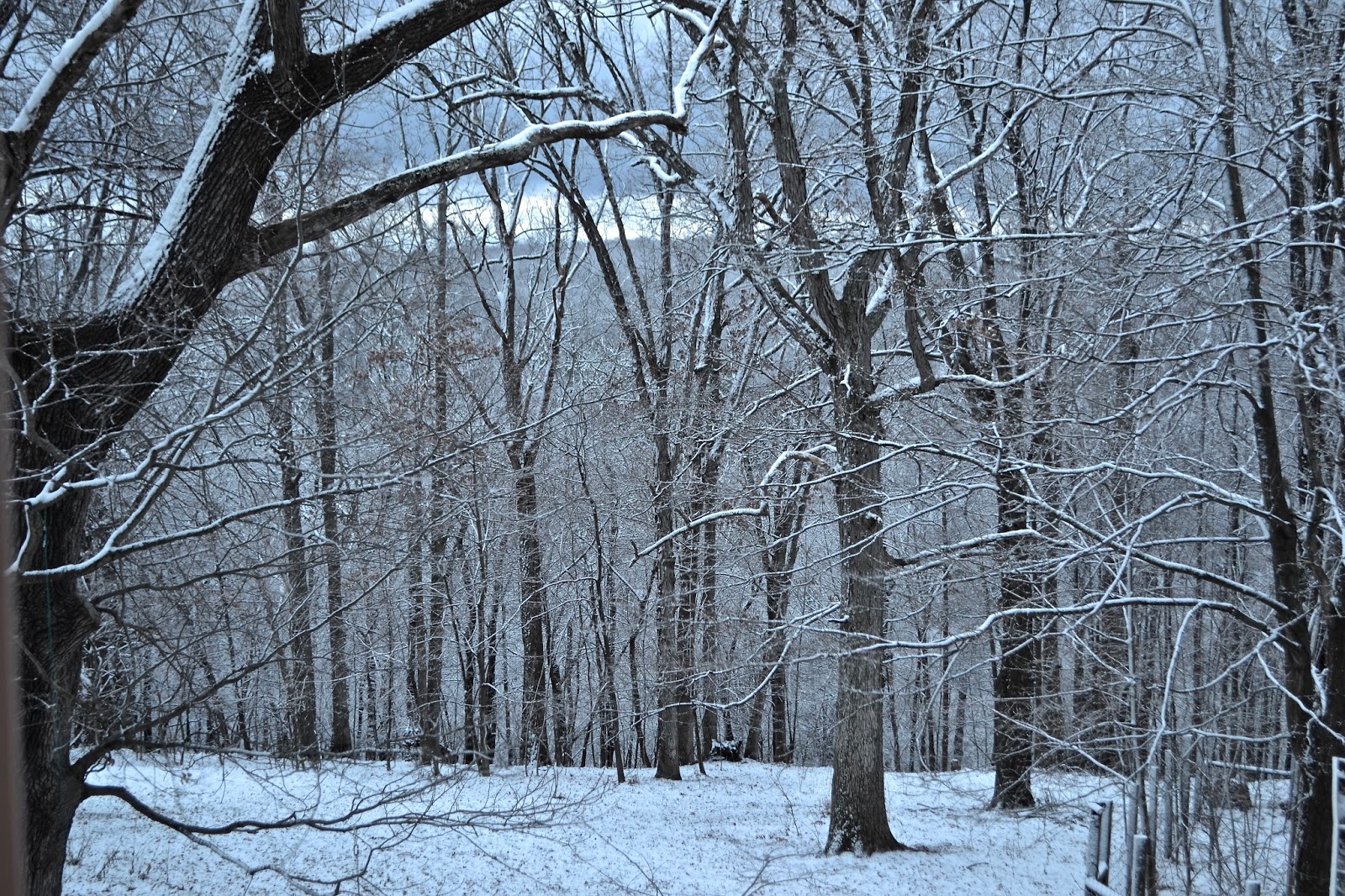
Jan 1, 2018 viewed from upstairs study
          For friends who notice the photos I post on Facebook, my love affair with deciduous woodlands will come as no surprise. The view from the upstairs desk mesmerizes me, even taking me from the mystical readings; maybe it’s not a separation but rather a union! These two must be of one spirit. The best pages breathe their origin, the inner fiber of tree; both transmit inspiration.
          My romance with books often gets teased by the spell of Maria Popova’s reviews. About a month ago, she featured David George Haskell’s recent book, Song of Trees. The tease enticed me to chose his earlier book: “The Forest Unseen: A Year’s Watch in Nature (Viking, 2012, https://dghaskell.com/theforestunseen/), winner of the National Academy of Sciences’ Best Book Award for 2013, finalist for the 2013 Pulitzer Prize in nonfiction, winner of the 2013 Reed Environmental Writing Award, winner of the 2012 National Outdoor Book Award for Natural History Literature, runner-up for the 2013 PEN E. O. Wilson Literary Science Writing Award…” 
         The book has 43 short chapters, each based on his observations and musings focused around a spot “of old-growth forest in the hills of Tennessee.” Every few days through the year, Haskell watches this forest mandela that is about a meter across. He connects this to Tibetan mandelas (p. xii). My intention is to read his book throughout 2018 and to ask this reading to inspire my walking in our woods. 
         Haskell’s first entry comes on January 1. He features lichens whose “vibrancy contrasts with the winter-weighed lethargy of the rest of the forest.” He continues:
Supple physiology allows lichens to shine with life when most other creatures are locked down for the winter. Lichens master the cold months through the paradox of surrender.” (p. 2) 
          Our woods, some 600 miles northeast from Haskell’s forest, look pretty locked down on January 1, 2018, still frosted with snow, temperatures below freezing all week, dropping to near zero at night. It is cold. Still I look for lichen, trying not to lock down for winter.

lichen on rocks ?
lichen on tree trunk ?

close up of lichen (?) on rocks 
          Haskell enriches his observation about the lichens’ paradox with an anecdote about a fourth century BCE Chinese Taoist philosopher and then elaborates the biological explanation. He comments on their means of survival:
By stripping off the bonds of individuality the lichens have produced a world conquering union. . . the lichen partners have ceased to be individuals, surrendering the possibility of drawing a line between oppressor and oppressed. (p. 3)
hmm...what's this?
Interesting...but sacrifice of individuality? Yikes--but that does sound rather like the Sufi mystics on surrendering the self. 
         While we might celebrate the “winning partnerships,” Haskell keeps us from imagining only unseen rosy hints when he also notes the presence of piracy and exploitation. And yet: “Even piracy is powered by collaboration” (p. 6). 

When you look out (and in), can you see these fascinating happenings?


Next up: “January 17—Kepler’s Gift” pages 8-11. The woods keep calling.

Thursday, May 25, 2017

Love Inseparable from Justice, Mercy, Compassion


5 AM-ish is the perfect time for coffee, especially on May 25, 2017, when the world turns sepia-toned, the tin roof echoes the gently falling rain, the robin joins in, not exactly singing but offering unabashedly itself. And the Amish-made rocking chair on the back porch, along with the man in it, creak just a bit. 
     Most Thursdays for the past decade would likely have found me at Starbucks when the door opens, 5AM, often the one on the corner of the Beltway and Route 1, pondering matters academic, like everybody else, wondering. Whatever: how we got here, how to get out without completely betraying the soul. 
     I don’t think humans are born nice and we’re not born mean either, but it sure looks like it. There’s a book within reach of my desk called Just Babies, mostly not-yet-read, but the point is that we’re born, at least most everybody is, with a capacity to prefer goodness and even with discernment of good guys. Just—as in born-with justice. Even before speaking or walking infants can choose the person who was nice, looking away from the actor who meanly stole the toy from another child, preferring the one showing love.
     What happens? How can so many people fail to see corrupt wanna-be leaders who are going to betray them without batting an eye? How can folks choose to watch a network spewing lies and hate? And then go to church, even send missionaries! The good book, just about any of them, warns of this. Freedom, this gift given humans, means suffering and most would rather not. The textbook we used in Good Stories preaches reciprocal altruism and asserts the necessity of imposing disincentives even to persons who collaborate with and who do not resist the evil-doers.
     Other good books teach purification. The person who wants to stone the one caught in adultery is not to be hated or vilified. The resistance needs to come from a clean heart because harboring hate destroys. So the person who committed the horrific hate crime on campus, the persons who support a power-crazed politiican, those who maim horses to win competitions—all these should be stopped but best not by those calling them nasty names. 

     Somehow love is still the answer. And it must be a love greater than we have grown, one inseparable from justice, mercy, compassion.

Wednesday, February 15, 2017

Good Hearts Grow Strong


A resonant moment in the “Water of Life” (Grimms’ version) happens early on when the youngest brother differs sharply from the older two especially when he gets down off his horse showing respect to the small voice. Although it’s more subtle, we were given advance notice with their contrasting hearts: his is filled with tender love for the father and theirs are dark in self-centered greed. The story happily rewards the good-hearted with the prize but only after he suffers and grows a heart strong enough to deal with the dark side. Humans are not meant to remain in the Garden but like Eve are destined to know of good and evil.
From that third son we’re offered some sense of the heart’s journey, but the Arabian Nights’ version of this tale gives an enriched account. The character who embodies the heart-journey continues to be figured as the third child but shifts to the feminine. Early in the story, it’s the third sister who playfully makes the big-hearted wish to marry the ruler. Such a lofty wish does come true, but her naiveté (along with that of her husband) prompts harsh consequences extending even into her own daughter who has to live the rough trek out into the knowledge of dark voices, growing strong enough to foresee the necessity of developing a protective strategy.  
When we seek to further amplify this theme of the good heart that develops into a strong heart, we’re fortunate to happen into a tale from Sierra Leone, Africa. The figure of the good but still innocent heart comes in “the daughter of the village” who is much loved by the ruler. The daughter gets separated from the village and is believed to have been taken by the ruler-above. In order to bring her back, the village has to absorb four or five (depending on the version of the story) unfamiliar and even unwanted characters. The nature of these characters includes: 
  • appearing to be lazy—while actually creating webs that are artistic but almost invisible connections, and by doing this work without being seen and thus without getting any credit, 
  • appearing to steal material objects—while redistributing wealth and thus incurring the wrath of the rich, 
  • appearing to inflict harm—while digging into the groundwork and too-familiar pathways, 
  • appearing to be unreliable, confusing, and inconsistent—while providing safe proximity to power, and 
  • appearing to inflict pain—while providing warnings of toxic materials and disclosures of high value.


Messages from these stories related to our real-world village here in 2017 seem almost too painfully clear. Where is the water of life that carries cleansing and renewal for our land, for all people of the world, including the rich folks who desperately, even if unknowingly, need renewal, inner and outer? Is the water/daughter still waiting, still captive, because we have not yet developed strong-enough hearts and generous-enough vision?  We must see into the secret spaces, share resources, open to hard truths, and expand into Emerson’s darkened knowledge that “a foolish consistency is the hobgoblin of little minds, adored by little statesmen and philosophers and divines.” And we must grow strong enough to endure the pain of dealing with poison within and without. Love that survives is not just altruistic; it also demands the discernment of giving with care so that resources are not turned to evil.
Martin Buber points our way to our divine resources and to the necessity of facing the old stories anew. It’s like admitting the stranger. 
“…face the Book with a new attitude as something new…its sayings and images will overpower…mold…ferment…enter in…to incorporate itself anew…To endure revelation is to endure this moment full of possible decisions, to respond to and to be responsible for every moment” (On the Bible, pp. 5-7).

For our world village to adapt and survive, we need to work and play as if the spiritual text is unfamiliar, not frozen but alive, so that we can receive the needed revelation. One friend from across the ocean who is in our Good Stories class brought in a perfect passage from Pushkin to help us open to the revelations from Books and tales:


Thursday, February 9, 2017

Amplifying the Water-of-Life Theme


Photo taken from my home office window this morning, Feb 9, 2017. Perhaps today’s “water of life” says to stay in and appreciate a less active form of beauty…
        One theme that we’re following in Good Stories is represented by the image of the “water of life.” Without water, we die; so the archetypal image pushes us to consider the essentials of living. For example, what do we do and what do we take into our beings that brings refreshment, cleansing, and renewal?
        Although water was not the dominant image in our first story, we did wonder if there was more to Luis in “Buried Treasure” than laziness. A sense of wonder signals a place to focus, a point of resonance. The primary evidence that Luis has mysterious power comes in his ability to stop the runaway horse. But we might need to backtrack if we want to explore this amazing gift. When we reflect back into the story, we notice an easy-to-skip-over detail about his initiative. In order to get on the path of the horse, he had to set out in search of a spring—that’s an image of the water of life. This action, the willingness to go after the water of life, although subtle it’s an opposite to laziness, and it leads to the connection with horsepower, with the spirit being, and with the “tatema” treasure.
       The focus on this moment in a story is what we’re calling resonance, and our backtracking and circling around the “hotspot” shows the beginning of “amplification.” To amplify is to increase understanding. Often it involves zooming in like we just did to get a fine focus on Luis’ action. Amplification also works by circling around a theme through finding different translations of a story, variations on the theme, and similar stories. Often we need multiple perspectives on an archetypal image if we are to gain enough texture so that applications to our individual lives can be appropriated.
        We amplify the moment where Luis goes in search of a spring by looking at other stories where a character looks for the water of life. One comes from the Grimms tales and another is from the Arabian Nights collection. A version of the Grimms’ “Water of Life” is included in Shah’s World Tales, and the hardback version has powerful illustrations by Melvyn Grant.

       "Golden Water" comes from Arabian Nights and contributes to our amplification by emphasizing female characters. It even features a younger sister who becomes a mother and has a third child who is female. This double presentation lets us see a continued development of the character that is needed to search out the water of life.
        Our resonance and amplification of the water-of-life theme can be portrayed like this:
1. We are struck by the advanced embodiment of a quality in Luis. He has been labeled as “lazy” but we see he has amazing capacity and wonder how a person might develop this ability. We might also note that sometimes a wonderful gift is not seen by others and even can be desecrated by them.
2. When we amplify this point of resonance with the Grimms’ “Water of Life,” we see the development of the younger son (who also is incorrectly perceived as weak). His character includes love and humility, instead of arrogance. We watch how his rather naive love progresses through suffering into a love that can face evil and that can design necessary strategy for dealing with betrayal.
3. When we amplify further with the Arabian Nights’ “Golden Water,” the person who has capacity to bring back the water of life is shown to have an advanced capacity for strategy related to self-defense.
4. The amplification of the water-of-life theme suggests next steps that might involve exploration of a related theme such as the nature of guidance. Concerning guides, our sequence of stories included 1) a spirit-being who just suddenly appears, 2) a small but powerful voice that has to be respected, 3) a semi-hidden dervish, and 4) a talking bird!
        Because exploration of the water-of-life theme offers to guide us in relation to the essential dimensions of life, it’s a good one for amplification. When we look for comparison stories that feature the water-of-life theme, we find it’s been labeled as tale-type 551 in the system devised by Aarne-Thompson-Uther (ATU). It’s classified within the category 550 “Supernatural Helpers.” Wikipedia shows links to 13 stories associated with “Water of Life” from around the world; sometimes the healing comes through something other than water.
       The guidance we find in amplification does not provide a roadmap, of course; but it does give us clues about the development of character that contribute to an enriched life. For example, in the Grimms’ version, the youngest son is motivated through love of his father in sharp contrast with his brothers’ desire for status and wealth. While his good heart helps him get the advice, directions, and resources he needs to get to the water of life, we find that love as he initially knows it won’t be enough. He is too trusting and has to suffer the development of a more mature love that includes discernment of traitors. His older brothers may be related by blood but they’re not related by heart, and he has to learn that love can include being strategic.
        In our primary textbook, On the Origin of Stories, Brian Boyd develops the meaning of reciprocal altruism: “I help you in the expectation that you may help me later” (p. 57). Boyd features this concept in his chapter “The Evolution of Cooperation” and continues throughout the book to show how reciprocal altruism has played a vital role in the survival of species and how it continues to be very significant in human’s cognitive development. Our ability to enact reciprocal altruism could be a significant development connected with the archetypal image of the water of life. Stories provide us with models of effective incorporation of reciprocal altruism in our lives.
        Passages from Boyd that elaborate reciprocal altruism include these:
"Cheaters will thrive in exchanges with altruists unless altruists discriminate against—refuse further exchange with, or actively punish—cheaters" (p. 57.
"For altruism to work robustly a whole suite of motivations has to be in place: sympathy, so that I am inclined to help another; trust, so that I can offer help now and expect it will be somehow repaid later; gratitude, to incline me, when I have been helped, to return the favor; shame, to prompt me to repay when I still owe a debt; a sense of fairness, so that I can intuitively gauge an adequate share or repayment; indignation, to spur me to break off cooperation with or even inflict punishment on a cheat; and guilt, a displeasure at myself and fear of exposure and reprisal to deter me from seeking the short-term advantages of cheating. We can reverse-engineer the social and moral emotions so central to our engagement with others in life and in story. (note 21) Rather than merely taking these emotions as givens, we can account for them as natural selection's way of motivating widespread cooperation in highly social species" pp. 57-58.

Monday, January 30, 2017

Art of Repetition with Variation


Repetition has a trickster quality, at first take seeming almost inartistic; and then, if we can shake off a bit of presumption, of presumed superiority, if we recognize our kinship with the noodlehead, we just might be positioned for awakening to a deeper level of feeling or understanding. Godly qualities like peace, justice, and love contain layer after layer with access available only by patient walking, step by step, through experiences and reflections that develop ability to see the hand of God and hear further into the Voice. Robert Alter’s chapter on repetition in The Art of Biblical Narrative reminds us of the power of the word that anticipates the phenomena of creation. He quotes Martin Buber on the biblical convention off “Leitwort”:
"a word or root-word that recurs significantly in a text, in a continuum of texts or in a configuration of texts: by following these repetitions, one is able to decipher or grasp a meaning of the text, or at any rate, the meaning will be revealed more strikingly" (p. 93).
Alter illustrates with the transition from Saul to David as King involving variations on the words “listen,” “voice,” and “word.” Saul, perhaps as a model for most of us, was rather slow to hear the word that said “to listen is better than sacrifice” (I Sam. 15:22).
My experience in teaching Good Stories continually proves the gift of re-telling. For example, we circle around a theme or character type and call this “amplification.” The Lazy Jack story was added to Good Stories to amplify Epaminondas with the way each fails to adapt. And then the so-called Lazy Man in “Buried Treasure” (also called “Tatema”) came in more recently to amplify Lazy Jack. The Tatema character allows us to move deeper into the strange way humans devalue persons and miss the gift they hold because the so-called lazy person is the one who stops the runaway horse and gets the silver coins that the Working Man only sees as stinky mud. 
But it took this sixth or eighth repetition for me to feel a particular value, an affection, for the Working Man whom on earlier takes I’d dismissively seen simply as a rather crass materialist. This time, when applying the strategy of taking the whole story inside as well as making external applications, I appreciated the connection between the two characters. The working man delivers the treasure to the horse-stopping man’s house. Like Lazy Jack’s ethic of showing up at work day after day even when he’s devalued each time, the working man does the grunt work. The two figures in Tatema are called compadres (Wilson Hudson, Healer of Los Olmos, p. 128-) suggesting a connection even stronger than friendship. 

I’ve been so fascinated with the one who dramatically stops the horse, that I’ve missed listening to the message from the worker. This time I began to realize that I might want to feel more appreciation for the part of me that just shows up. To be on-time for over a hundred beginnings of a semester and almost every class session in those forty years—while not the breath-stopping moment—still has merit. If we’re going to advance peace and justice, both on the inner and the outer spaces, complementary roles need to be valued, even when they fuss and just “don’t get” each other.

Saturday, March 19, 2016

The Long View of Old-Growth Cultures

Looking north, predawn, March 19, 2016.

In our study of Good Stories, in addition to reading print versions of the stories, the primary text has been Brian Boyd’s On the Origin of Stories: Evolution, Cognition, and Fiction. Standing out to me from his survey of the dynamics among his subtitle’s three forces are two essential themes: cooperation and reciprocal altruism. In order to survive (evolution), in order to advance thinking and consciousness (cognition), and in order to engage, to imagine, and thus to advance culture (fiction/story), good guys need to work and play together (cooperation). In my simplified paraphrase, Boyd even asserts that for the good guys to advance culture and civilization, they must be willing to punish those persons who share with the goons. To put it even more starkly: altruism has to be strategic; new-agey unconditional love gives away too much to the haters. Boyd says:
Cheaters will thrive in exchanges with altruists unless altruists discriminate against—refuse further exchange with, or actively punish—cheaters. . .
For altruism to work robustly a whole suite of motivations has to be in place: sympathy, so that I am inclined to help another; trust, so that I can offer help now and expect it will be somehow repaid later; gratitude, to incline me, when I have been helped, to return the favor; shame, to prompt me to repay when I still owe a debt; a sense of fairness, so that I can intuitively gauge an adequate share or repayment; indignation, to spur me to break off cooperation with or even inflict punishment on a cheat; and guilt, a displeasure at myself and fear of exposure and reprisal to deter me from seeking the short-term advantages of cheating. We can reverse-engineer the social and moral emotions so central to our engagement with others in life and in story. Rather than merely taking these emotions as givens, we can account for them as natural selection's way of motivating widespread cooperation in highly social species. (pp. 57-58; Kindle, 686-691)

         A refreshing complement to Boyd has come in reading Robin Wall Kimmerer’s Braiding Sweetgrass: Indigenous Wisdom, Scientific Knowledge, and the Teachings of PlantsKimmerer, a botanist and the director of the Center forNative Peoples and the Environment, also shares her vision in a 2012 TED talk: Reclaiming the Honorable Harvest Perhaps her text will soon be added as required reading for Good Stories. Reciprocity strands through Kimmerer’s scientific accounts of plant life and her reflections on the teachings they offer for sustainable living as well as for depth of meaning, extending even into the spiritual realm. I continue to be moved by her grace in re-member-ing our country’s colonization of the “new world” and its many native inhabitants: stone, plant, animal, and human.
         One particular section contributes especially to the prospects for cooperation. In her study of old-growth forests in the Pacific Northwest, she underscores a kind of bittersweet hope for us in our time of endangered global warming.
         When resources begin to run short, as they always will, cooperation and strategies that promote stability—strategies perfected by rainforest ecosystems—will be favored. The breadth and depth of these reciprocal symbioses are especially well developed in old-growth forests, which are designed for the long haul.
         Industrial forestry, resource extraction, and other aspects of human sprawl are like salmonberry thickets—swallowing up land, reducing biodiversity, and simplifying ecosystems at the demand of societies always bent on having more. In five hundred years we exterminated old-growth cultures and old-growth ecosystems, replacing them with opportunistic culture. Pioneer human communities, just like pioneer plant communities, have an important role in regeneration, but they are not sustainable in the long run. When they reach the edge of easy energy, balance and renewal are the only way forward, wherein there is a reciprocal cycle between early and late successional systems, each opening the door for the other. (p. 284)

         In my own experience, I’m cautiously hopeful in voluntarily taking less while increasing gratitude and seeking more deeply while expecting multiplicity. Love, for example, comes in so many colors and textures. In sleeplessness at two a.m., love invites meditation. A touch of pain advises adjusting motion: slow down while weeding and hear the birdsong. Hurt feelings expand care and prioritize inner understanding over external approval.

         And stories, the good ones, open windows to rooms capable of holding all this. Our next one might be “The Mechanical Horse” because it pushes us to realize the dangers of demanding immediate gratification. The eye wanting it right now loses the soft gaze that attends to hard wisdom found in old-growth cultures.

Thursday, February 25, 2016

Advancing Peace & Justice through Teaching-Story


      We want to continue to emphasize the subtitle of our Good Stories course: Teaching Narratives for Peace and Justice. When we work with Good Stories, how are we advancing our prospects for moving further in capacity for building a peaceful world, both inside ourselves and with others? Several concepts developed in our textbook, On the Origin of Stories: Evolution, Cognition, and Fiction by Brian Boyd, are especially important in relation to this.

Explanation of Four Themes
1. Let’s continue focusing on metarepresentation. This concept explains how we are able to move across the levels as we translate from the story images to the local and individual levels. For example, in Buried Treasure, we abstract an archetypal image like the “tatema” that Luis is given.  For another example of the treasure archetype, we imagine a representation for the “water of life” in Golden Water.
         As we move from the detail in the story to the abstract idea, we are doing meta-representation: the box with silver coins is recognized as “treasure” which could also be seen as the coin Jack gets, as the puppy Epaminondas receives, and as the golden water found by the youngest sister. This amplification enriches our ability to see the treasure in a variety of forms or representations. Each of us has access to treasures, but they are easily missed unless we develop vision to see them in varied forms and to see potential the way the Creator does with the speck of mud retrieved by Little Coot in Beginnings.
          When we have the abstract image (in other words, when we “meta-represent”), we are then prepared to translate the quality across into the other levels. For example, look at how we are finding the “treasure” in our selection of a college major. If we make the fitting choice, this field of study provides riches for ourselves and for others. One treasure comes in the joy of learning (Individual Level: Inner), another is the ability to earn a living (Individual Level: Outer), and a third could be the benefits that the knowledge and skills provide for others through the applications in the world (Local Level). If a person makes the right choice on engineering, he or she should love learning about it and the projects he or she develops could provide valuable structures for others.
         Working with stories exercises our capacity for metarepresentation, and we can use that developed capacity throughout life in ways that support peace and justice.

2. The theme of cooperation is perhaps the most important component needed at our time in history in order for the advance of peace and justice. Working with stories contributes by showing us examples and by developing our ability for empathy. The story about Kanu and the Strangers is a prime example. We see the chief of the village model the ability to anticipate strangeness as virtue, and when we identify with one of the strangers we befriend aspects of ourselves that have been isolated and devalued (cf, Daniel Deardorff, The Other Within). This modeling and inner development enables us to participate in social change that reduces hostility and enhances equal opportunity.
         Boyd emphasizes this theme throughout his book because fiction (story) gives us practice with taking on the role of others who model character traits we need to build. For example, we may better appreciate patience by empathizing with Psyche; we may build capacity for courage and the judgment needed to meet with dangers by joining Kanu’s team as they accepted and enacted the challenge of bringing back the daughter of the village. This quest can be seen as bringing back the emergent feminine qualities such as cooperation that are essential for sustaining collaborative life.
         Boyd elaborates on the theme of collaboration:
We need to infer others' predispositions and their likely intentions and actions, which may in turn be based in part on their attempts to guess ours. If this hypothesis is correct, higher intelligence emerged primarily as social intelligence, through a cognitive arms race to understand conspecifics and to reveal to or conceal from others our own beliefs, desires, and intentions. Because theory of mind was first opened as a field to explore within primatology, the social intelligence hypothesis was first called the Machiavellian intelligence hypothesis. Chimpanzees seek to understand one another especially in order to compete, sometimes by deception, for food, sex, or status. But researchers have begun to realize that we have probably reached our unique human level of theory of mind through pressures to cooperate more closely against other groups: we understand one another so much better because unlike chimpanzees we have crossed a cooperation divide and from infancy have a greater motivation to social engagement and shared attention than any other species.[note 68 Wilson, Evolution for Everyone; ] (p. 141-2; Kindle Locations 1597-1603). 
         During their fifth year, children grow into a distinctively human theory of mind, capable of metarepresentation--of understanding the process of representation--and involving beliefs as well as desires, goals, and intentions, a state that no other animal appears to reach. At this higher, exclusively human level, theory of mind becomes not only an intuitive psychology but an intuitive epistemology. No wonder it is hard to attain, even though as adults we employ it effortlessly. (bold emphasis, mine; p. 145; Kindle Locations 1640-1647). 

3. The empathy we develop through feeling with a character in a story can expand our understanding of the attitudes, values, and behaviors needed to cooperate, to accept differences (like Kanu does), and to expand our value system in ways that extend justice. Boyd elaborates on empathy: Empathy arises from recognizing others' goals and desires, a capacity necessary in an individualized social species.  (p. 138; Kindle Location 1561).
A third aspect of the theory of bonds is social exchange. In the human case this extends far further than in any other individualized society and has led to the evolution of a complex suite of moral emotions to solve problems of trust and commitment.[note 55] We can observe the basis for human moral emotions in other animals, especially primates: empathy, which as Darwin noted makes individuals much more able to live in groups; [note 56] a sense of fairness and self-righteous indignation, recently found experimentally even in capuchin monkeys,[note 57] and demonstrated cross-culturally in humans;[note 58] forgiveness and reconciliation, needed to repair relations, observed over the last twenty years in many species;[note 59] emotions like generosity and gratitude; and a capacity for detecting cheating in social  relations . . . Nature has endowed us with a moral capacity "much like a gyroscope at rest," and culture's role is "to spin it and establish its orientation."[note 64]  (p. 140-141; Kindle Locations 1584-1591).

4. Stories are true but they are true at a level of abstraction that has to be translated into “real-life” situations if we are to manifest these truths into our individual and social worlds. In order to translate the archetypal images that resonate within us, we need the resources of imagination, play, and creativity. Boyd emphasizes how these elements have been vital in the movement of culture and civilization.
They [Darwin machines] cannot find the right answer beforehand: there is no single right form of life, no single right antibody, no single right synaptic link, no single right move.(note 32) But they can generate possibilities that the environment tests. Survivors generate new variations and face new rounds of tests, so that even without preplanning, success accumulates.  (p. 120; Kindle, 1387-1389).   
In art understood as a Darwin machine, works are not somehow created to fit the cultural environment. Instead they are generated, unpredictably, in the minds or actions of artists, and selected first by them in accordance with their intuitions about their social world, and then by this world itself. (note 40)(p. 123; Kindle, 1414,)
Art develops in us habits of imaginative exploration, so that we take the world as not closed and given, but open and to be shaped on our own terms. In and through art, we readily turn the actual around within the much larger space of the possible, the conditional, and the impossible. Art opens up new dimensions of possibility space and populates it with imaginative particulars.
Art builds our confidence, at the individual and the group levels, in shaping our own destinies.   (p. 124; Kindle,1427-1429, 1435)
         The connections among the four themes from cooperation to creativity are shown in these excerpts from Boyd:
But a system of unconscious emotional contagion [that works before language and below conscious awareness and has evolved along with sociality] allows us to coordinate genuinely cooperative intentions. Mirror neurons, [whose function was discovered only in the early 1990s,] fire when we see others act or express emotion as if we were making the same action, and allow us through a kind of automatic inner imitation to understand their intentions and attune ourselves to their feelings. 
Quoting Goleman:
When people are in rapport, they can be more creative together and more efficient in making decisions ... Shared attention is the first essential ingredient
Animals learn best to attune themselves to one another through the pleasures of play, taking turns, checking to see that their partners still seek the "high" of intense mutual engagement.(note 19) Humans, more flexible in behavior and dependent for much longer in childhood, broaden and lengthen social play, not only in childhood but right throughout adult life. And they extend it, crucially, into the cognitive play of art.  (p. 103-4; Kindle, 1186-1195)
And through pretend play and fiction we learn to try out the positions of others, we attune ourselves spontaneously to the shifting emotions of an unfolding story, and we encounter story after story that embodies prosocial values in memorable, emotionally compelling images, actions, and outcomes (p. 106; Kindle, 1214-1215).   

Application of the themes
As we move into planning our second digital media project, these themes are the stepping stones:
1. Through resonance, we each identify the metarepresentations that are worthy of development because they connect with the unique talent and gift given to each person. In other words, the authentic “hits” made in the experience of Good Stories, of teaching-narratives, offer the source of the archetypal images capable of advancing peace and justice.
2. Just as we are doing in the journal assignments, Digital Media Project 2 translates across the levels so that the point of resonance (such as Psyche opening the treasure chest or Chameleon looking like Ruler-Above) gets applied in our individual character and at the social level. For example, DMP2 could include a comic with an inner dialog where a self-doubt is challenged by the way a divine ruler would see the situation. Another part of DMP2 could show a photo of an experience though UMCP's alternative breaks program where a home is being made for persons living in sub-standard conditions. The voice track could tell how this is like anteater’s work in the Kanu Story and how it expands the chances for peace and justice.
3. In order to extend the understanding and the texture of the key archetypal image and the related quality, DMP2 amplifies by showing drawings and photos connected with several stories. For example, let’s assume that my points of resonance tended to relate to the points where someone received guidance: the youngest brother stopping for the small voice, the young sister listening to the old woman and to the talking bird, Psyche getting help from the reed and from the tower. Through metarepresentation I connect these points of resonance with the archetypal figure of the Guide. My project amplifies with images representing the stories just named and then translates the Guide across levels so that I creatively play forward my developing understanding of Guide/Guidance.
         The empathy needed to recognize the guides we might otherwise miss out on can be developed by amplification of this theme. In the Grimms’ Water of Life, the guide was a voice that was perceived by the older brothers as too small to be worthy of their attention. In Golden Water, this is shown as a person who could be missed as just looking like a haystack. Psyche needs to listen to the reed alongside the river if she is to recover the golden wool. When we amplify the archetypal them of “guide” with these stories, we develop empathy needed to value small voices and to look into the hidden places.
         Also, the Golden Water story shows a progression of the guide archetype as it suggest development of an inner voice (some call this “gnosis”). The youngest sister is in search of the “treasures” (figured as golden water, singing branch, & talking bird) that would make her home complete. This could represent the development of her complete being, personality, or wholeness.  She gets guidance for this from the figure that was initially hidden in the mass of hair, like a haystack and then later from the talking bird. As the guide changes from human to the bird, we might understand this as developing more independence from outside mentoring and more reliance on an inner voice. In addition to gnosis, this kind of knowing has been elaborated as “felt sense” by Eugene Gendlin, as “feeling” in natural horsemanship, and as a sense of destiny. http://dochorsetales.blogspot.com/2014/10/destiny-directions.html

4. As just illustrated, the making of this second digital media project invites us to nurture and practice our capacity for imagination, play, and creativity. A sense of humor is often the best tonic to get through difficult experiences. Lazy Jack’s bumbling attempts in his slowly developing ability for adaptation in moving day to day resulted in the laughter that connected with the beloved.
         Imagination also allows us to connect with resources such as the ones given for Psyche’s tasks. When Psyche loses contact with Eros, the stage is set for bouts with Depression because Eros represents the source of creativity and vitality. Our well-being depends on our nurturing our relationship with play, and play deserves to be taken seriously along the lines of the way that Vivian Paley portrays it in her accounts such as A Child’s Work: The Importance of Fantasy Play and You Can’t Say You Can’t Play

Questions to think about:
1. After viewing “Beginnings,” name and illustrate your point of resonance.
2. Explain how the Beginnings story, preferably the place in the story that you just named, connects with Boyd’s explanation of the importance of creativity. See excerpts from Boyd in part 4 above.

3. Use your creativity to make a visual that you could use in DMP2. The image should show a photo of you in a place where you are getting creative ideas. Put in a thought bubble that tells about an insight or a wondering you are making based on the Beginnings story. For example, it might say, “Like Little Coot this idea I have about [fill in your idea] looks like just a useless speck of mud, but…”