Monday, January 13, 2020

Layla spark-lets


          Notice
              the little everyday 
                  moments spilling droplets 
              of beauty, 
                  of Beauty. 

                   It’s so easy to 
                       speed past
                            life 
                              slipping by. 

                              Layla steps 
                                   lightly, spark-
                                       lets of light, 
                                             of Light.


Tuesday, November 26, 2019

The Still Point


Very interesting illuminations burst across from the fusion coming out of initial readings in two texts. Titus Burckhardt, in Sacred Art in East and West, details how the essential form of a holy structure composes the symbolic themes connected with line, square, circle, and center point. Each of us in our daily work and play, especially in our craft and art, engage with and are mediated by these inevitable structures.
        Burckhardt explains how these elements lead to two- and three-dimensional crosses, mandalas, icons, and on into altars, temples, and other spaces that support contemplation of the divine. Themes include the centrality of sacrifice, transformation, even the containment and resolution of “all cosmic antinomies” (p. 25). Temples extend from altars, the significance evident in this footnote 
“Union with the Divine Essence always comprises, as phases or aspects of a single spiritual act, the reintegration of all the positive aspects of the world—or of their interior equivalents—in a symbolized ‘hearth,’ the sacrifice of the soul in its limited aspect and its transformation by the fire of the Spirit.” (p. 28)
   The physical structures express the fully human along with the cosmos: 
“the temple has a spirit, a soul and a body, like the man and like the universe…the architect of the temple identifies himself with the building and with that which it represents; thus each phase of the architectural task is equally a phase of spiritual realization. The artist confers upon his work something of his own vital force; in exchange he participates in the transformation which that force undergoes by virtue of the sacramental and implicitly universal nature of the work” (p. 47).
   Huston Smith in Forgotten Truth elaborates the multiple dimensions of the cross, including: “a horizontal cross is a mandala, a sacred enclosure, round or square, with typically four approaches to a ‘hidden treasure’ that lies at its center” (p. 23)
“For the point at the center of the three-dimensional cross that gives rise to the order of nature concomitantly creates the souls that inhabit that order, not just in the moment of their conception but continuously, instant by instant as they pursue their trajectories. . . If it strikes the reader as presumptuous to equate his personal center with the center of the cosmos, he must be reminded that physics requires him to do just that because space is relative and curved, the center of the physical universe is for each observer the point from which his observations proceed…The Hermetic formulation is exact: ‘God is a sphere whose center is everywhere and circumference is nowhere.’” (pp. 29-30)
   Smith elaborates in a footnote at the bottom of the page with a quotation from Meister Eckhart:
 “‘The soul that enters into God owns neither time nor space…But it stands to reason, if you consider it, that the space occupied by any soul that enters is vastly greater than heaven and earth and God’s entire creation. I say more: God might make heavens and earths galore yet these…would be of less extent than a single needle-tip compared with the standpoint of a soul atoned in God’” (p. 30).
   Reflections on these texts along with “meditation of everyday life” (referenced on p. 31 by Smith) lead to a sense of being directed to release all reactions, such as those spinning off the political miasma that tumults about us, to let these go into the "black hole.” 
“Passage through the ‘gateless gate’ (Mu Mon Kan) that guards the holy center can be disorienting. If it takes the form of a powerful satori it can feel as if one has been sucked into a ‘black hole’ where physical laws are destroyed. When eyes have accustomed themselves to the new, ethereal light, however, one sees that no movement has occurred. Length and breadth had already withdrawn into the cross’s horizontal center; now the vertical axis too collapses. Renouncing the space it had embodied to make an important but provisional point, that axis now withdraws the ontic, value distinctions that once it metered. . . Superfluous and ego-aggrandizing activity must be stilled, but the stilling of such activity clears the way for pure effectiveness—action that is powered by force that is concentrated and energy assembled” (p. 31; Smith follows with quotations from the Tao Te Ching, the Chuang Tzu, Pascal, and Eliot’s “still point” “where there is only the dance”).
        Let’s release all the worries for dear ones, let every trouble of the world be taken into this still point. This the only way to love. The way to the Only Love.

Sunday, November 24, 2019

Finding Pearls

Nov 23, 7:31AM
From Huston Smith’s Beyond the Post-Modern Mind, I came away with the importance of escaping the spell of postmodernism in order to affirm the possibility of the development of higher capacity in human spirituality. While acknowledging the benefits from the scientific age, Smith asserts that scientism veils humans from understanding our divine inheritance because foundational to the domineering mindset imposed by science/postmodernism is the pervasive premise that humans advance from lesser forms rather than from greater. When in the spell of postmodernism, humans are blocked from realizing ourselves as created in the image of God. In postmodernism, we may say the words while denied the infusion of spirit. And in the thrall of material mindset following religious prescriptions risks separation from divine guidance. Postmodernism gives highest values to quantification as evident in the materialism that ever seeks more money, status, sex, and other things. Postmodernism leaves us bereft of the sense of quality.
     A resource for breaking this spell of postmodernism, then, may be found through investing in quality rather than quantity. One view of qualities comes in the Names of God, as expressed in the Islamic tradition. Perhaps the most compelling of these qualities that calls to me is Beauty. As a follow-up to Beyond the Post-Modern Mind (in addition to beginning Smith’s earlier Forgotten Truth), I’m finding myself drawn to Titus Burckhardt’s Sacred Art in East and West. An antidote to the toxicity of materialism comes in the unveiling of the divine in everyday living. Burckhardt explores an aspect or quality of this in the sacred art of “the five great traditions”: “Hinduism, Christianity, Islam, Buddhism, and Taoism.” For example:
“That which the Christian view of things grasps by means of a sort of loving concentration on the Word incarnate in Jesus Christ, is transposed in the Islamic view into the universal and the impersonal. In Islam the Divine Art—and according to the Koran God is ‘artist’ (musawwir)—is in the first place the manifestation of the Divine Unity in the beauty and regularity of the Cosmos. Unity is reflected in the harmony of the multiple, in order and equilibrium; beauty has all these aspects within itself. To start from the beauty of the world and arrive at Unity—that is wisdom. For this reason Islamic thought necessarily attaches art to wisdom; in the eyes of a Muslim, art is essentially founded on wisdom, or on science, the function of science being the formulation of wisdom in temporal terms. The purpose of art is to enable the human environment, the world so far as it is moulded by man, to participate in the order that manifests most directly the Divine Unity. Art clarifies the world; it helps the spirit to detach itself from the disturbing multitude of things so that it may climb again towards the Infinite Unity.” (pp.16-17)
Most everyday, my spirit finds refreshment by expecting to see beauty in nature. 
Nov 19, 7:11AM
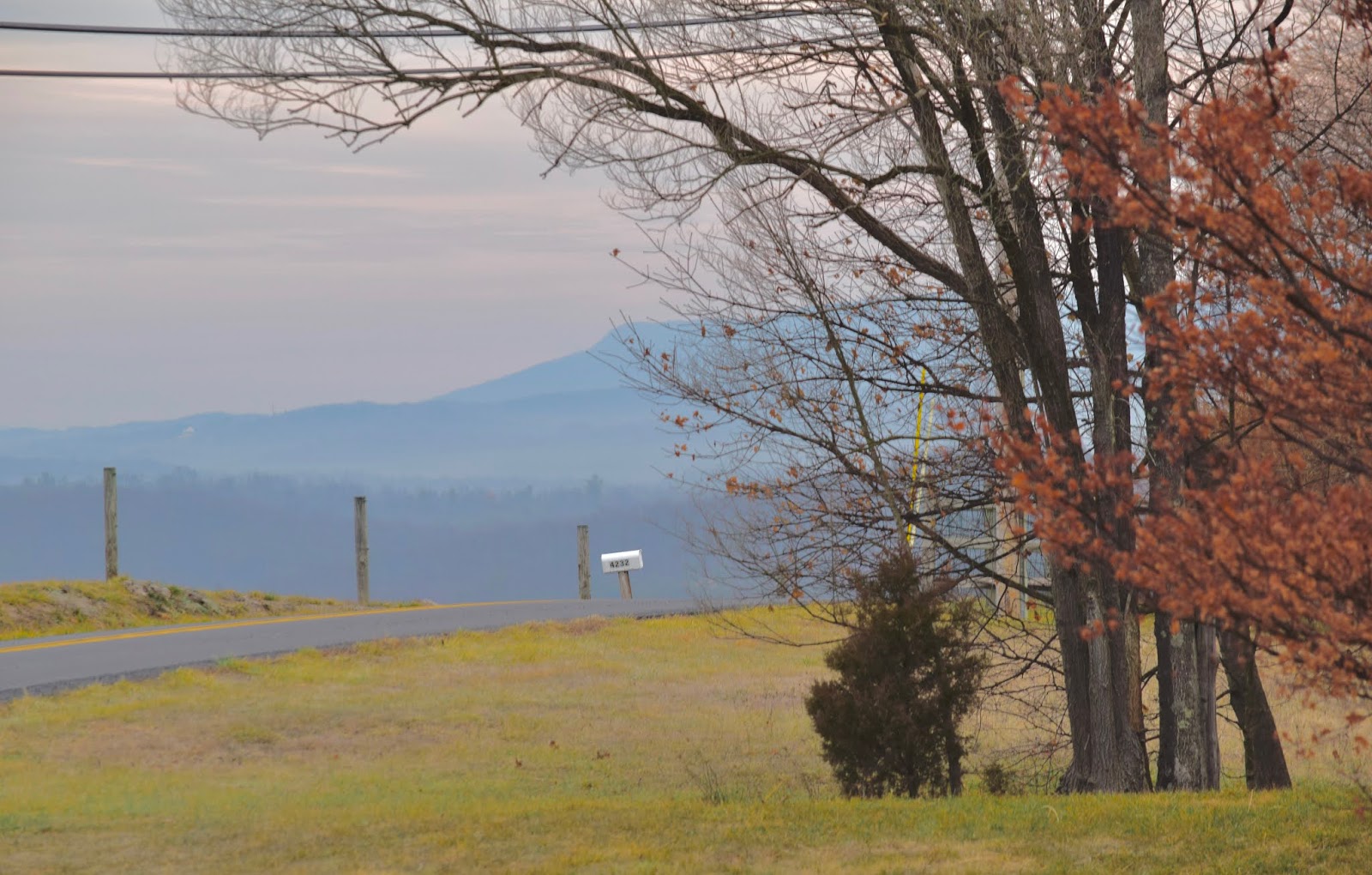
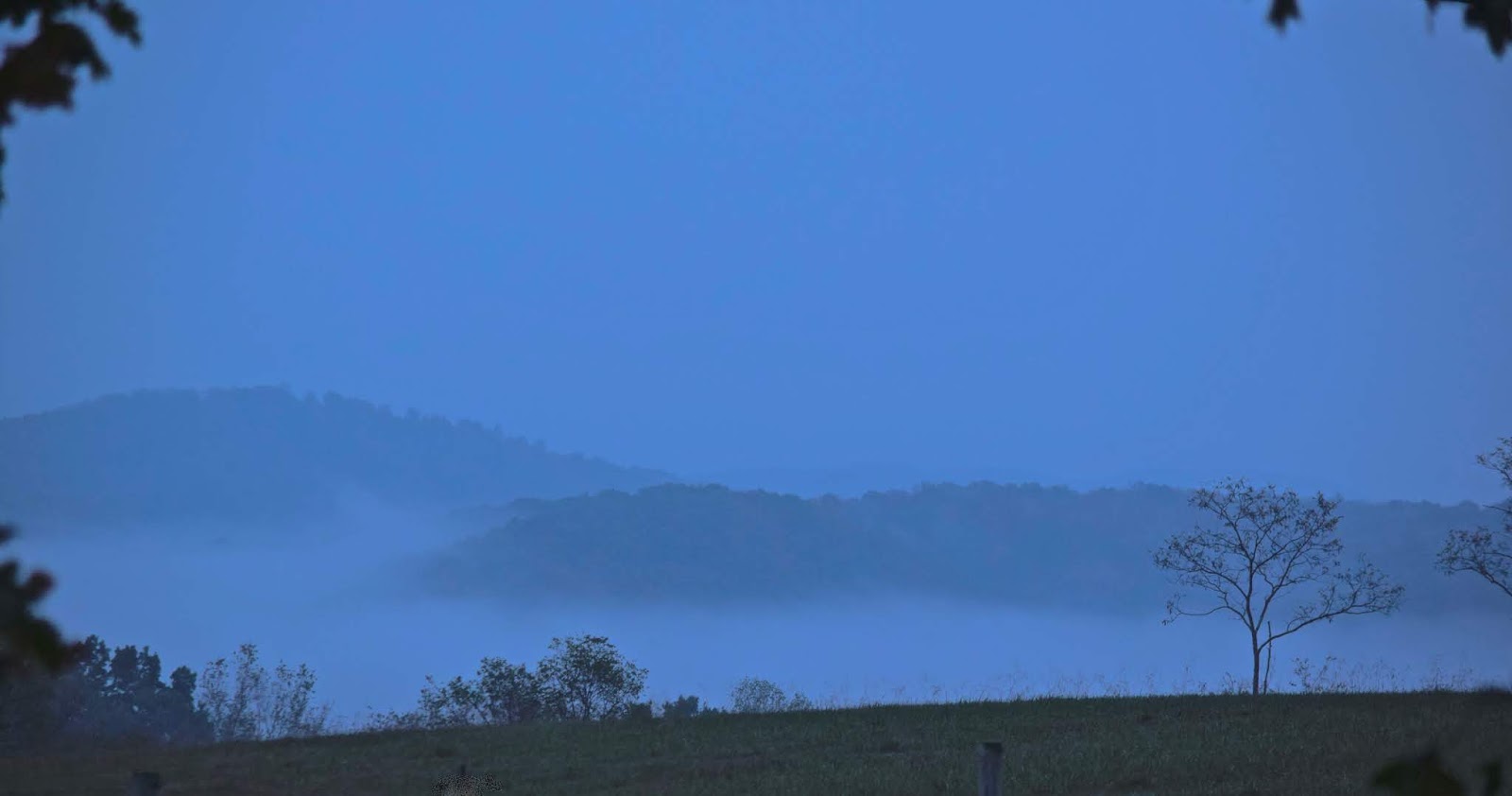
Sometimes the harmony of color and line is increasingly revealed by editing photographs. For example, by adding contrast or by moving the center point, the otherwise hidden beauty emerges more clearly. Looking expectantly, loving the variation of light over shadow, and playing with images all guide the discovery into subtle manifestations of the quality of beauty.
Nov 19, 8:46A harvesting the fallen tree

Nov 21, 4:45P river birch planted this year

     It’s interesting that the same day I’m drafting the above a Facebook friend posted from the fiftieth discourse of Rumi’s Fihi ma fihi:
“The sciences and crafts are like measuring the sea in cupfuls; the way to finding pearls is something else. Many a person is adorned with every accomplishment and possessed of wealth and beauty but has nothing of this intrinsic meaning in him; and many a person is a wreck on the outside, with no fairness of feature, elegance or eloquence, but within is found the intrinsic meaning that abides forever. It is that which enables and distinguishes humanity.” (p. 195, Signs of the Unseen, translation by Thackston)
A year ago today, Nov 24, 2018

Saturday, November 16, 2019

Longing into Certainty

Photo taken today 7:34:12 AM attempting to represent
“this moment in which the transcendent reveals itself as the immanent”

Three wonderful readings are converging, or perhaps they spiral, about. The “what” that they are mediating goes into the nameless and might be called “the mystery” as long as the nature of the inarticulate unknowable is respected. Huston Smith says that this “what” holds the certainty that summons the truth-searcher and carries one past the destabilizing turbulence permeating the current age. This transport, mediated with mystery, validates longing that otherwise risks being demeaned as escape or fantasy or even madness.
     Iris Murdoch, in the first page of her sixteenth book, The Sacred and Profane Love Machine, opens with a character having “A sensation which he felt almost all the time now, a sort of mild aching disgust and lassitude, [that] made him unable to concentrate his mind.” Her portrayal, reminiscent of postmodernism’s miasma, with its devilish variations so evocatively portrayed here and through her fifteen previous novels, concentrates again so that we might loosen, and perhaps even gain release from the toxic illusion.
     Huston Smith’s book, Beyond the Post-Modern Mind, very helpfully describes this “worldview that science introduced,” and more importantly, for me at least, points the way beyond, toward “apophatic theology, the via negativa” (p. 59), toward where mystics focus. And that’s the link to the third reading: Michael A. Sells, Mystical Languages of Unsaying.
     These three readings are working together so that the attraction I’ve long felt to Rumi and Hafez makes more sense, and the increased understanding offers to bridge from the sacred into the profane and back again, and again as the indwelling flows without cease. Murdoch’s stories are especially valuable as the richness of story surpassing the intellectual gold of exposition allows compassion to develop so that the otherwise unloveable might be approached. But finding the way takes more than is humanly possible. The divine needs to come through. 
     For this to happen, I believe we need at least these three: the ground of understanding, the sweet waters of compassion, and the warm light from the spirit. In short, the mystical union. That’s what Rumi, Hafez, and all the charmers of radical love tantalize us toward. Michael Sells concentrates the teachings from the entire book in the final pages when he says this is “This moment in which the transcendent reveals itself as the immanent.”
“The affirmation of transcendence—when taken with full apophatic seriousness—then turns back upon itself. The paradoxes of transcendence and immanence, the coincidences of opposites, the displacement of the grammatical object—all are in violation of the conventional logic that functions for delimited entities…”     This moment in which the transcendent reveals itself as the immanent is the moment of mystical union. [emphasis added] At this moment, the standard referential structures of language are transformed: the breakdown of the reflexive/nonreflexive grammatical distinction in the antecedence of a pronoun [It sees it(self) through it(self) in it(self)]; the breakdown of the perfect/imperfect distinction (it always has been occurred and always is occurring). At the moment of mystical union, the divine attributes are not known to a nondivine subject, the distinction of deity and creation and the duality of lover and beloved are undone. The attributes appear in the mirror, and the image in the mirror is divine in human and human in divine. As soon as the attributes are ‘known’ (perceived as objects by a subject other than them) they harden into idols. They can be realized only through union and self-manifestation. . . This realization is both timeless and utterly ephemeral.” (p. 212)
Michael Sells continues so that the language and the effect of the spiritual poets may translate more easily into the daily offerings pregnant with the grace of mystical union.
“The moment in which the ego-self passes away entails a ‘bewilderment,’ ‘love-madness,’ a ‘being driven out of one’s wits.’ Conventional rationality is built upon the very structures that are momentarily superseded in mystical union.” (p. 212)
     Terrible thing about a worldview is that when it’s the only view known there’s a significant risk that no other world can be believed nor born. Like if a Jonah were in the whale’s belly his entire life, could he have conceived any other possible world? Persons who only experience the narrow oppressive texture of the postmodern world may be so depressed in spirit and vision that they are condemned to be swallowed their entire lifetime. Thank God for sending prophets, poets, and other teachers throughout created forms to display the divine and to invite the mystical union.


Sunday, October 27, 2019

Leafless Prophecy

   Most days the camera lens wants to avoid telephone lines, poles, and yellow stripes on the road. It tries to exclude ugly concrete forms and hunting stands. Warnings caution about glare on closed windows. Watch out for unwanted shade from screens. Question including any unraked fallen leaves. 

      But for this moment, grey skies invite forgiving. Maybe paradise says so. Widen beauty enough for the shadowed lands. Know connections demand accepting imperfection. Windows look out even when the glass isn’t polished. And reflections matter much. 

      In mid-life years, leafless limbs of winter whispered forebodingly; old, now bare, trees prophesy life eternal. 

Prophesy: (transitive verb) to predict with assurance or on the basis of mystic knowledge; (intransitive verb): to speak as if divinely inspired.


Sunday, October 20, 2019

Rain Does Alchemy


In the softly falling, at least this time of year, almost within the mirroring eyes of the camera, and more so in the further process of editing the image, the green-yellow turns to gold. Then looking through the window and rain-blurring across time, see and look into the fall of these dampened leaves as by spring slowly the soil turns rich, golden yielding new life. And this window opens into the hidden great mystery: 
“. . . the deep meaning . . . [unseen by] men who have made themselves incapable of seeing him [Christ] and have hidden him from themselves . . . and he is never there when one interprets events by historical materialism, under the guise of theology, instead of grasping the spiritual history ‘in Hurqalya’” (p. 319, note 11 for page 173, Corbin's Spiritual Body and Celestial Earth). 
 As we must surely realize by now, we are engaged in “the battle for the soul of the world” and could certainly avail the resources of “the world of Hurqalya, into the Angelic World” (p. xvii), a place described in the previous blog, where we might
“come face to face with the Earth not as a conglomeration of physical facts but in the person of its Angel . . .  essentially psychic event which can ‘take place’ neither in the world of impersonal abstract concepts nor on the plane of mere sensory data. The Earth has to be perceived not by the senses, but through a primordial Image and, inasmuch as this Image carries the features of a personal figure, it will prove to ‘symbolize with’ the very Image of itself which the soul carries in its innermost depths. The perception of the Earth Angel will come about in an intermediate universe which is neither that of the Essences of philosophy nor that of the sensory data on which the work of positive science is based, but which is a universe of archetype-Images, experienced as so many personal presences.” (p. 4)

The note cited above elaborates a selection from ‘Abd al-Razzaq Lahiji where Corbin translates and comments on our alchemical opportunity to participate in the magical mystery bridging/blending Heaven/Earth:
“Every being of the two universes, the intelligible and the sensory, has its archetypal Image in this intermediate universe a self-subsistent Image with autonomous existence. . . It may happen that a being of this autonomous world of Images makes himself visible, makes his appearance in our material world, and can be perceived in it by the outer senses. Bodies which are perfectly polished and transparent bodies, such as mirrors, still water the atmosphere, are the places of the epiphany in our material world of the beings of the world of archetypal Images. In the same way, man’s Imagination is also the place of their epiphany.” (p. 172-3)
Like this
Photos taken Sunday morning, October 20, 2019


Sunday, October 13, 2019

Leaves Yellow, Fall, and Light

Perhaps the most distinctive mark of good reading, particularly in relation to its value in guiding the spiritual pathway, comes in the manner in which, well before the final pages close, a breeze has already freshened into and has begun returning from other works. Usually, but not always, the flow moves toward authors referenced in footnotes, sometimes and not too often a link goes to additional texts by the original author. And best happens when the spirit takes oneself outside language and into inspiring life experience itself. In any case, the flow carries one deeper, further into richer meaningfulness and awe: in brief, “Ahh” and “Wow!” echoing with “Amen.”
Before “finishing” The Sufi Path of Knowledge: Ibn al-‘Arabi’s Metaphysics of Imagination (and already well aware that I’m properly advised to circle back to pages marked, back to the extensive footnotes, and better yet to return for another full reading), Chittick’s references to Corbin’s Spiritual Body and Celestial Earth had led to my taking it from the shelf and to doing so with almost-readiness to engage/absorb bits of the mystical text. I had been prepped by Chittick to be a bit more open about “angel-language” and to take a chance in terrain that I’ve usually detoured around because it smacked of “new-age” superficiality. 
Reflecting on this hostile avoidance to angels, I find it’s strange. How can it be that angel-talk has tended to be a turn-off? Have I disconnected from the prominent presence of angels in the sacred Books? Immediately leaping to mind: The angels with Daniel & friends in the fiery furnace and the lion’s den (Daniel 3 & 6); The awesome that meets Mary and Mary at the tomb and transforms grief and despair into abiding faith (Matthew 28); and Muhammed’s guides for the Night Journey (including al-Buraq), as well as attendants in the Night of Power: “The angels and the Spirit descend therein, by the leave of their Lord, with every command” (Q 97:4, p. 1540 in The Study Quran: A New Translation and Commentary). Similarly, I’m asking how can I be so close-minded about angels while finding myself fascinated with Khidr, particularly the account of Khidr and Moses that involves the resurrected fish (cf. the Water of Life motif) and the highly significant theme around the surrender of legalism in favor of mind-bending re-creations, suggesting the possibility of direct transmission of personal truth.
Several possible, inter-related, reasons for resistance to angels spring to mind: 
    • Science rules the Academy crowning empirical proof and dismissing (even ridiculing) other forms of knowledge, especially anything mystical.
    • Proliferation of stuff claiming to be spiritual (sometimes called “New Age”) makes difficult the discernment of material actually qualifying for the prophetic tradition.
    • Fear of falling out of control makes a person wary of trusting anything outside rational knowledge.
    • What about the devil!
I don’t listen much to music other than wind chimes, bird songs, and soft raindrops on fallen leaves; but the other day, while driving as these mysteries of angelic visitation were blurring about in my being, I tapped on the car CD and Carrie Newcomer sang: “…there’s bound to be some trembling, some risk and some mistakes, something lost and something gained, and Little Earthquakes. . .” (from album Gathering of Spirits). So perhaps it’s Little Earthquakes that happen when Angels enter the liminal edge. Of course, it’s safer to stay with scientific, factual certainty and to toss all angelology indiscriminately into a new-age bin. 
But, then, doesn’t this resistance carry a whiff of noxious pride of intellect? Having spent forty-plus years in the academic complex proved to me that there are deadly limits in the narrow scientific worldview and convinced me something’s missing of vital importance. Retirement might be given especially in order to dedicate priority to what’s been squeezed to the margins, particularly that which concerns life beyond. Of course, the shenanigans of spiritualists persist and walking where angels tread is fearful; but time grows short and we have promises to meet. 
While the connection slowly articulates, I’m drawn to explore the possibilities involving the degree of our relationship with the natural world (including love of animals and plant life) and the way this correlates directly with our access to the spirit world (including angels or other presences). In other words, our closeness to the voice of animals and plants corresponds to some degree with our capacity to hear God’s messengers. About a thousand years ago, a work by the Brethren of Purity (Ikhwan al-Safa’, “a tenth-century esoteric fraternity based in Basra and Baghdad”) forecast the cost of human insensitivity; but “folktales” (especially those having talking animals) too often go unheeded, and so the environmental crisis resulting from human arrogance now threatens our existence because our “civilization” has burned so brutally. S.H. Nasr provides an introduction to a recent retelling of the Brethren’s Epistle recalling his engagement with the text when writing his doctoral thesis at Harvard in the mid 1950’s:
“The message of the story appeared to me to be particularly timely because even then there was a keen intuition in my mind concerning the impending crisis in man’s relation with nature, a subject to which I turned a decade later in my Man and Nature, written at the dawn of general awareness of what came to be known as the ecological and later environmental crisis” (p. xii, The Animals’ Lawsuit Against Humanity, Fons Vitae, 2005).
This text by the Brethren of Purity offers a place for me to continue to contemplate and to allow the voices of animals to open. A helpful, although dense, complement comes in the flow mentioned earlier, particularly Henry Corbin’s Spiritual Body and Celestial Earth. For example:
“To come face to face with the Earth not as a conglomeration of physical facts but in the person of its Angel is an essentially psychic event which can ‘take place’ neither in the world of impersonal abstract concepts nor on the plane of mere sensory data. The Earth has to be perceived not by the senses, but through a primordial Image and, inasmuch as this Image carries the features of a personal figure, it will prove to ‘symbolize with’ the very Image of itself which the soul carries in its innermost depths. The perception of the Earth Angel will come about in an intermediate universe which is neither that of the Essences of philosophy nor that of the sensory data on which the work of positive science is based, but which is a universe of archetype-Images, experienced as so many personal presences. In recapturing the intentions on which the constitution of this universe depend, in which the Earth is represented, meditated, and encountered in the person of its Angel, we discover that it is much less a matter of answering questions concerning essences (‘what is it?’) than questions concerning persons (‘who is it?’ or ‘to whom does it correspond?’), for example, who is the Earth? who are the waters, the plants, the mountains? or, to whom do they correspond? The answer to these questions causes an Image to appear and this Image invariably corresponds to the presence of a certain state. This is why we have to recapture here the phenomenon of the Earth as an angelophany or mental apparition of its Angel in the fundamental angelology of Mazadaism as a whole, in that which gives its cosmology and its physics a structure such that they include an answer to the question, ‘who?’” (pp. 4-5).
Good readings, as noted above, best inspire life experience. A couple of places I’m attentive to find this include:
* When I’m with Leg’cy (riding or just alongside her), feel the form of Harmony coming through, often involving a sense of Power that carries light (lightness) and a thrill of joy. Notice how this contrasts with the perverted exercises of power evident in the material world.
* When I work/play/imagine with photographic images, attend to the “form” of Beauty that comes through. Engaging with and listening to different representations of the same view seems to open my being more present to the voice coming through the natural world from the Source. Perhaps the Earth Angel that Corbin notes is here somewhere.
photos taken this morning, Sunday, October 13