Tuesday, October 4, 2022

Mysticism and Nature's Manifestations

Perhaps the impetus to return to Annemarie Schimmel’s Mystical Dimensions of Islam came via someone posting a best-books on mysticism. Thanks to that person who gave the assist because Schimmel's book is heavy, imposing with its 500 pages and extensive footnotes. Her scholarship enriches every page, and this demands/invites careful reading—but well worth the investment. The depth of expertise provides guidance through the writings and the lives of so many seekers of truth. Facing this impressive work, it would be easy to take a passive stance; but instead Schimmel calls for active engagement to quest into the divine:

“In interpreting Islamic mystical texts, one must not forget that many sayings to which we give a deep theological or philosophical meaning may have been intended to be suggestive wordplay; some of the definitions found in the classical texts may have been uttered by the Sufi masters as a sort of ko’an, a paradox meant to shock the hearer, to kindle discussion, to perplex the logical faculties, and thus to engender a nonlogical understanding of the real meaning of the word concerned, or of the mystical ‘state’ or ‘stage’ in question. The resolution of apparent contradictions in some of these sayings might be found, then, in an act of illumination.” (pp. 12-13; cf Sells’ Mystical Languages of Unsaying)

Among the definitions of Sufism, Schimmel includes a gem from Rumi: “‘What is Sufism?’ He said: ‘To find joy in the heart when grief comes’ (Mathnawi 3:3261).” [p. 17; Nicholson translates “sorrow” in place of “grief” and references Q 57:23.] 


One of the precious gifts of reading this book involves a deepened impression of the interconnection between approaching the Divine and participating in the praise of creation. For example, writing about Dhu’n-Nun (d. 859) and early Sufi mystics, Schimmel translates: 

“O God, I never hearken to the voices of the beasts or the rustle of the trees, the splashing of the waters or the song of the birds, the whistling of the wind or the rumble of the thunder, but I sense in them a testimony of Thy Unity, and a proof of Thy incomparability, that Thou art the All-Prevailing, the All-Knowing, the All-True”  (p. 46)

These meditations resonate with the tonalities vibrating from walking amid gardens and woodlands, open to photographic compositions, to close-up revelation of intricate design, to graceful flitting in of butterflies or falling leaves, and to the comforting remembrance

Screensaver appearing alongside the draft as this was written.

as treasured savings float onto the screen.

Screensaver appearing alongside the draft as this was written.

This participation in nature's manifestation, too, may be offered and realized as praise, as prayer, as presence.


How many times was I tempted by Schimmel’s accounts of the mystics when she referenced their texts to take up one of those books from a shelf? A stack of them soon built up alongside my desk [see photo at top].  Now having completed Mystical Dimensions, should the next reading be another of Schimmel’s or Franklin Lewis’ much-praised Rumi or one of Lewisohn…?


Although I hope to engage each of those texts, it’s another she discussed that’s now bringing light: Sir Muhammad Iqbal's Javid-Nama (translated by Arberry). For example, 

“… when yearning makes assault upon a world

it transforms momentary beings into immortals,” [p. 94, lines 2221-2222]


“Wherever you see a world of color and scent

out of whose soil springs the plant of desire

is either already illumined by the light of the Chosen One

or is still seeking for the Chosen One.”   [p. 98, lines 2331-2334]

Thursday, August 18, 2022

The Long and the Short of It All: God Is—

Everywhere. 

Diffused in radiance from here to the far beyond. 

In the so-short-lived blooms and no less in the scattered petals.

In the middle of the night before last, calling off sleep, flooding with invisible light and in too many soundless songs playing.

And that's all right. 

     Some questions have been asked many times and prayers sent up. To the Almighty: why the suffering? the injustice? And how can the promised Beloved be known more intimately? 

     Might the answer come in dreams and then spinning free-association fragments of lines read, keeping me awake? It seems best to give gratitude, not grumpiness. Sleep can be deferred, somewhat like the way mystics sacrificed, a hint like ascetics went without. These visitations just might be what the searcher of spirit, of heart and soul longs for.


From my personal library of a few hundred books related to mysticism, I've been reading recently in a few: especially Rkia Cornell’s provocative Rabi’a: From Narrative to Myth, Coleman Barks’ Hummingbird Sleep, and Helminski/Blaylock’s Rumi and His Friends.


Looking back over a dozen or so previous blog entries: A mystic, simply put, is someone tenuously claiming personal experience of the Divine. 


 As noted in another previous blog, one of my favorite texts engaging the great mystery surrounding this is Michael Sells’ Mystical Languages of Unsaying. 


As Sells' title indicates, the numinous presence eludes definition yet gives off just enough scent and/or taste to guide the next half-step, the leaning into. 


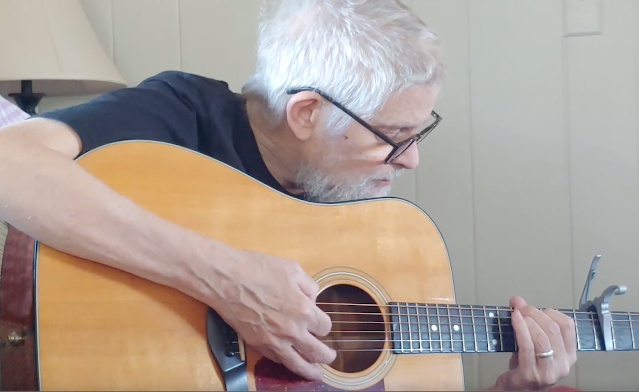
     The most poignant touch of this right now, for me, rises from continued remembrance of my soul brother so recently passing over, now whispering from the other shore in secret code that he promised in our long night before his going. Just a few years ago, like yesterday, he was playing this song:


Link: https://drive.google.com/file/d/1_xDWaR407ytRkXdTr6Edu4hvTTvs2NYg/view?usp=sharing


Putting my photos with John Amin’s playing and reflecting in the midnight hours led to these reflections:


Around three a.m. semi-waking from a dream

about a subtle way of teaching, intent on

the other. Trust. All about the mystic.


Through Van Morrison’s hymn, my brother 

John Amin evokes the calling, like the foghorn warns

or summons to the shore. Both of them.

The mystical living/dying. Midnight hours

in meditations say "Stay in the fire. Don't run

from transformation. Trust the One. Burn

through fear, set free desire to know too much.


Find Coleman’s fireflies and under stones, the guard

rails to innocence, to God, inside and out.

Going home Mystic firefly highway love song


Because while trying to hold impossibles we're

slipping away too. After all detaching is

the gypsy soul, butterfly wings lift fireflies.

So don't hold too tight. Love and let go–


But trust the faint spirits flickering at midnight

Guardian angels if faith tells true Visitors

Cross and carry bridge Unite. Believe in

Midnight sight

The mystic highway…

The subtle teaching. It's Sufi walking. Gift

Of the inner Divine

Tuesday, August 2, 2022

In Memoriam: Amin John David Whalen


In Memoriam: Amin John David Whalen. July 19, 1955 - July 31, 2022.
Don't look to me--or anyone else--for making sense of death or suffering. Despite reading a dozen or so books on Job, this ongoing revelation steeps with mystery, a holy wholly-personal transmission, respectful of each individual's indwelling Divine secret, carried by the Holy Spirit in sacred conversation, capable of building the space and time to transcend mortality.

     These reflections of mine emerged somewhere in the past week, following all-night vigils, administering pain-reduction medications and softly restraining my soul brother Amin John David Whalen from trying to get free from the hospital-style bed, as his longing heightened for the further shore. In these closing days of his time in this world, as the everyday grasp of reality was slipping through our clasped hands, we meditated on bewilderment, that frustrating theme so often poignant on the path, perhaps one of the best markers of the Way. 


     In the final week of his sojourn here, I was keenly reminded of his sharp intellect, his delightful sense of humor, and his bridging into the mystical dimension. One night, I was reading aloud from Rumi, sometimes comparing Coleman Barks’ version in The Glance with the more literal translations of Nevit Ergin from Divan-i Kebir, Meter 3. One poem that we treasured goes: 

“O friend, even the word ‘friend’

Doesn’t fit between us.

If I try to say, O Beloved,

I am unable to say ‘O Beloved.’


Even ‘Ah,’ goes back to the place

From which it comes.

I closed the road to my mouth,

I can’t wail…” 

(p. 174 in Ergin; cf p. 9 in Barks)

One of the other poems we read included the term “ambergris” and I mumbled trying to recall its meaning. Amin managed to whisper “sperm whale,” somehow pulling up the knowledge that ambergris is produced in the digestive system of sperm whales. While I'd been wondering if he was attending at all to the words, he was typically (and to borrow a phrase noted by another of his life-long friends) "ahead of the curve." Amin was dedicated to creating ways to make the world more meaningful.

Another special and world-bridging moment in these final days came in the middle of a night. In one of our final attempts to use words, I managed to figure out that his frustrating attempt to articulate with his partially paralyzed tongue wanted to convey the word “code." He seemed especially pleased when I guessed Morse code, perhaps finally clueing in to his fingers tapping on my arm. 

     But why bring that up? I'm still open to further revelation, yet my working notion is that he wanted to convey that communication no longer need be limited to our normal ways of connecting. Perhaps our experiences over the 35 years of friendship, many of them engaging the liminal edge, often coming through our mutual love of the mythic, the mystic, poetic, the spiritual was opening to more. . . I'm reassured of continuing connection with my partner as coming to mind is Jesus comforting his friends shortly before leaving this physical plane: "and behold I am with you always."

     Amin and I were often recommending readings to each other. As his medical prognosis turned more critical, I’d picked up Ghazali’s writing on The Remembrance of Death and the Afterlife and gave a copy to Amin. While neither of us completed the book, we connected on passages such as: “As for the gnostic, he remembers death constantly, because for him it is the tryst with his Beloved…” (p. 8 ). Amin also pointed us to a text found at the back of The Study Qur’an by Hamza Yusuf on “Death, Dying, and the Afterlife in the Qur’an.” It includes this:

“In the Quran, the Arabs’ denial of the resurrection of the dead is addressed and refuted in several simple yet engaging metaphors. It declares repeatedly that all things in this world have been made in pairs, of which the duality of life and death is a central one, highlighted in sundry verses. Coupled with life and death is the other essential pairing of this world (dunyā) with the Afterlife (ākhirah), a pairing whose sign, the Quran declares, should be discerned alongside Heaven and earth, both of which are commonly repeated motifs in the scripture. Given that all things in this world are created in paired opposites, it would follow that this world also has its opposite, which is the next world. Furthermore, as this world is temporal, its opposite is logically speaking eternal.”   

[Hamza Yusuf, “Death, Dying, and the Afterlife in the Qur’an,” In The Study Quran: A New Translation and Commentary, Nasr, Seyyed Hossein; Dagli, Caner K.; Dakake, Maria Massi; Lumbard, Joseph E.B.; Rustom, Mohammed. (p. 1820). HarperOne. Kindle Edition.]

     So much of spiritual guidance flows from the gift of Remembrance. I remember sweet moments (along with some not so sweet) in company with Mr. Whalen and our mates on the back porch, near the ocean, near Abiqui . . wherever we were. . . but especially when near natural beauty like the earth that Amin so passionately defended and proactively collaborated in order to forge more eco-friendly consciousness and action.  Remembering one special time takes us back to 2016 to Chincoteague with music composed and performed by Mr. Whalen.


     Another collection of wonderful memories are from a trip in 2018 to their New Mexico place near Abiqui. 


Not long before their move to Ireland, John sent me a video he made called Dreaming Donegal. I'll continue trying to provide access for you to listen and view it. Meanwhile, continue remembrance. . .


Thursday, May 12, 2022

Longing and Certitude

“... and there’s not a trace of doubt…” Even a monkey-mind acknowledges the longing for certitude. Such longing itself testifies to the presence of God, but how easily this affirmation, the longing instead gets misconstrued as abandonment and taken as an elevator down to despair. 

     Mystics and other seekers of God have tried for ages to tell us that our conception, the picture we hold of “reality,” determines what we know and how it’s revealed.  A person’s construction depends on whether he or she is committed (a) to things of this world or (A+) to God’s World. It takes a special faith to discern Truth in a culture shadowed for centuries by the legacy of “cogito ergo sum” (I think therefore I am), a world entrenched in the “scientific method.” How demanding it is to live in reliance upon the Word Who speaks in a whispered stillness that’s often heard only by the individual in his or her unique aloneness, often inarticulate and unconfirmed by anyone else. And yet, how thrilling! How awesome the inner temple of God!

“… the answer [to the more superficial aspects of human’s condition], as Ghazali had discovered for himself, lay only in internalizing the formalities of religion through ‘tasting’ (dhawq): personal religious experience… the only way to certitude” (p. xviii, Introduction by T.J. Winter to Al-Ghazali: The Remembrance of Death and the Afterllife)

     Neither the furthest reaches of human thought nor one’s hardest effort can reach the Divine; for the assurance of God’s presence rests upon God’s grace. When left to the human mind, doubt is certain. The great Divine cannot be known through human resources alone.

“How far apart is the one who seeks proof through God from the one who seeks proof for God! The one who seeks proof through God acknowledges the due that he owes, and affirms the matter by reference to its original existence. One seeks proof for Him only because one has not reached Him. Otherwise, when was it that He became absent, such that one would need to seek proof for Him? And when was it that He became distant, such that one would need to follow the tracks of created things to find him?” (p. 240,  Shaykh Mohamed Faouzi al-Karkari, Introduction to Islamic Metaphysics: A Contemporary Sufi Treatise on the Secrets of the Divine Name).

     When I enter the wholeness of the ephemeral blossom of life/death, when nested into the beauty of early sunlight igniting the yellow and red poppies, the inner light reflects God’s Majesty. This conjoining of the Immanent and the Transcendent, the yielding to paradox, breaks open the false self, the prison of human arrogance, the pride of self-sufficient intellect. That which is true can only be found in the One, in God; for Truth is one of God’s names. In surrendering completely to God’s Sovereignty, we may be admitted, by God’s Grace, to the Unity, to the full mystery of Love, Peace, Justice, Mercy, Beauty, and the full spectrum of Life/Death.

“Thus, dear disciple, if you wish to be among the people of union, you must gather the beautiful names within your true self. For the secret of the names lies in their gathered totality. God says: ‘He taught Adam all the names” [Qur’an 2:31], and the totality of the names is the secret of union of the everlasting presence.” (p. 230,  Shaykh Mohamed Faouzi al-Karkari, Introduction to Islamic Metaphysics)

     Richard Rohr’s meditation this week elaborates the textures of longing drawing especially on Teilhard de Chardin and Saint John of the Cross. Quoting from Teilhard:

“God does not offer Himself to our finite beings as a thing all complete and ready to be embraced. For us God is eternal discovery and eternal growth. The more we think we understand God, the more God reveals Himself as otherwise. The more we think we hold God, the further God withdraws, drawing us into the depths of Himself.” (Pierre Teilhard de Chardin, The Divine Milieu: An Essay on the Interior Life (New York: Harper and Brothers, 1960), 119. Note: some changes made for inclusive language.)

“John of the Cross describes the doubt that disrupts a soul in the dark night, when all sense of knowing God is absent. Mirabai Starr translates from John’s classic work Dark Night of the Soul:

‘The deep suffering of the soul in the night of sense comes not so much from the aridity she must endure but from this growing suspicion that she has lost her way. She thinks that all spiritual blessing is over and that God has abandoned her. She finds neither support nor delight in holy things. Growing weary, she struggles in vain to practice the tricks [prayer practices] that used to yield results. . . The best thing for the soul to do is to pay no attention to the fact that the actions of her faculties are slipping away. . . . She needs to get out of the way. In peaceful plentitude, let her now say “yes” to the infused contemplation God is bestowing upon her. . . . Contemplation is nothing other than a secret, peaceful, loving inflow of God. If given room, it will fire the soul in the spirit of love. [John of the Cross, Dark Night of the Soul, trans. Mirabai Starr. Riverhead Books, 2002), 67, 68–69, 70.]

Tuesday, April 19, 2022

Presence Here and Now


April 18, 2022: the most photo-compelling day of all—at least in these parts, at least in recent memory… a day not even necessary to leave the comfort of the house in order to frame the visions of beauty. 


Perhaps this date gifted a reminder of the guidance: “Be here now!”  While travel to the exotic

Oct 28, 2018


may expand horizons and spark imagination;

True Signs Apr 28, 2018


a vital window to the spiritual life comes home in being present to each individual’s gift from the Divine, the True Self. 

     Absorbed In yesterday’s amazing display, my being thrilled in the awesome manifestation of the images containing wholeness:  light and dark,


lime-green spring holding bleak winter—a holy embrace.


Often beauty takes breath away with rainbow-hued dusk 


Winter Containment


in morning-lit webs of life

Now we see Dimly


in the contours tracing the pathways we travel; 


Contours. Jun 1, 2021


and yet, perhaps more importantly, holding steady in the present sometimes sends revelations through the worn boards of the barn, and


and like the grace of aging well, in the lichen-covered, decaying, no-longer functional, or then 

Certainty


from an always-open doorway.


And Beauty is but one of the names of God. The Presence manifests in Long-Suffering (cf Ann Bedford Ulanov, The Wizard’s Gate), 


in giving to the struggle for Justice, and, of course, through longing further in the almost unendurable, soul-stretching hands of Love.


“Jesus said: I am the light above everything.

I am everything.

Everything came forth from me,

and everything reached me.

Split wood, I am there.

Life up a rock, you will find me there.”


[Gospel of Thomas 77. Cited in:

Perennial Wisdom for the Spiritually Independent, p. 45]


Wednesday, February 9, 2022

Light and Shadow in Late Winter

The play of light hints across remnants of the last snowfall and flows on into the woodland with its still-clinging autumn leaves that this early morning call glowing in dawn’s promise, as if all this transmits a stay/leave tease in and out of hibernation’s haunt. 


Today’s social media (also flickering pre-dawn) featured a post by David Whyte on Love, a word ever transforming, calling "come in--if you dare..." Remember its falling-in and falling-out, the cross between the known and the further on. From Consolations, Whyte offers this:


Thursday, February 3, 2022

Winter Containment


While not a big fan of winter, this season perseveres in proving the value found in stripping down to the basics, the beauty revealed in moving toward the essence. Spiritual teachings stress the hard truth of suffering that is necessary in order to remove the superficial and to recover the True Self; for example, “die before you die,” “to thine own self be true,” and “He who knows himself (or his-self, his soul, his mind) knows his Lord.” The latter phrase is provocatively elaborated in an article by Dom Sylvester Houédard, “Notes on the More Than Human Saying: ‘Unless you know yourself you cannot know God.’” For example, he writes:

“The authentically Semitic act of gnosis (daath, yada ‘to know’) is always the fruitful experience of the one living God as Lord and so as obliging us; e.g. knowledge of God’s goodness to us imposing on us goodness to others. It is the certitude of faith fruitful in deeds; the knowledge that produces likeness and makes us like what we know, that deifies and makes us deiform.”

Houédard also links to the Creation and to “the essence prior to the creating word”:

“Whoever wishes to know the divine breath must first know the cosmos for he who knows himself knows his Lord who is manifest in him. (The ‘distress of the Divine Names at the non-manifestation of their effects’ prior to the creating word of command, is not only why the obligating command is for us to show the effects, but indicates that the divine and uncreated energies are themselves an eternal manifestation of the essence prior to the creating word: the former is developed by Eckhart, the latter by S. Gregory Palamas.)”

         Along these lines, Antonio Machado’s Llamó a mi corazón  has long been a favorite, memorized and often recited in Spanish and with Robert Bly’s English translation. The second end rhyme (viento/quiero) capsulizes the essential quest, the human/divine drama; and the entire poem radiates with images of the True Self. 

Llamó a mi corazón, un claro día,

con un perfume de jazmín, el viento.

 -A cambio de este aroma,

todo el aroma de tus rosas quiero.

Quiero translates as “want, wish, or love”; viento as “wind.” And as the ensuing lines tell, this wind speaks to the soul, calling to account for the tending of the garden: The human accountability for nurturing the divine spark poignantly noted with the longing for the aroma of the roses, the watering of the flowers, and heartbreak over the lost inheritance. As often shown in revelation, this wind carries the holy spirit, the breath of God, the communion to and from the Self.

     Like a compass needle, my directional finder points to “true self,” perhaps always, certainly as years advance. Far back in the beginning, only twenty-seven verses into the Good Book, we’re given our inheritance and destiny: “made in the image of God.” And yet, the currents of life confuse the signal system, or maybe the pathway back home takes threads of many colors, making the unique texture of each creation. 

In any case, the current clue that seems to be key to getting there comes in this teaching: “to know yourself is to know your Lord.” That magnetic pole star has been featured across religions and through varied major writers.

Readings resonate as soul guides, especially ones on gnosis/mysticism, suffering, and wholeness. As the season of winter draws inward, space has opened to engage volumes that previously seemed too demanding: C.G. Jung’s Aion, The Grail Legend by Emma Jung and Marie-Louise von Franz, Barbara Hannah’s Striving Toward Wholeness, and writings by St. John of the Cross, including Edith Stein’s The Science of the Cross.

The swirl, stirring up muddy stuff from the bottom, among readings, dreams, and weather, seems to compose in the effort and evidence of holding together opposites. Barbara Hannah writes:

“In the empirical Self of psychology, light and shadow form a paradoxical unity, but in the orthodox Christian concept the archetype is split into two irreconcilable halves…

This inevitably involves us in a crucifixion of the ego between these two irreconcilable opposites. Of course, there can be no final extinction of the ego, for that would destroy all possibility of consciousness. The ego has to submit, however, to a continual crucifixion between the opposites, to those dreaded conflicts in duty…" (pp. 28-28, Lectures on Jung’s Aion).